
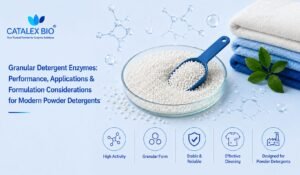
Modern Powder Detergents Demand More Than Traditional Cleaning Chemistry
From household laundry powders to premium detergent formulations, today’s consumers expect exceptional cleaning performance—even in cold water and shorter wash cycles. Modern detergents are expected to remove stubborn stains, protect fabrics, retain colors, and support increasingly sustainable washing practices, all while maintaining cost-effectiveness. For detergent manufacturers, meeting these expectations requires much more than conventional detergent chemistry.
One of the key technologies enabling this transformation is enzyme technology. Unlike surfactants and builders that primarily loosen and suspend dirt, enzymes actively break down complex organic stains into smaller, water-soluble molecules that can be easily rinsed away. This targeted action allows detergents to deliver superior cleaning performance while reducing the need for higher chemical loading.
For powder detergents, enzymes are typically supplied in granular form. Granular detergent enzymes not only provide excellent cleaning performance but also offer the physical characteristics required for efficient manufacturing, including excellent flowability, low dust generation, uniform blending, strong granule integrity, and improved storage stability.
As a trusted granular detergent enzyme manufacturer, supplier, and global exporter, Catalex Bio offers a comprehensive portfolio of high-performance Protease, Amylase, Lipase, Cellulase, Mannanase, and Pectinase, together with customized 2-, 3-, 4-, 5-, and 6-enzyme blends developed specifically for modern powder detergent formulations. This article explores how granular detergent enzymes work, their advantages, the different enzyme systems available, and the formulation considerations that help manufacturers achieve reliable cleaning performance.
What Are Granular Detergent Enzymes?
Granular detergent enzymes are biologically active catalysts formulated into stable granules for incorporation into powder laundry detergents. Unlike enzyme powders, granular detergent enzymes are formulated into stable granules with controlled particle size, making them easier to handle, blend, and store during detergent manufacturing while helping ensure consistent performance during large-scale production.
Each detergent enzyme targets a specific class of stain, allowing multiple enzyme activities to work together for broader and more effective stain removal. Rather than simply lifting dirt from the fabric surface, enzymes hydrolyze complex stain molecules into smaller fragments that are more easily removed during the wash cycle. This targeted mechanism enables powder detergents to remove a broader range of everyday stains while enhancing overall cleaning performance and formulation efficiency.
Besides improving cleaning performance, the granular format simplifies manufacturing by reducing dust generation, improving material flow, and promoting more uniform enzyme distribution throughout the finished detergent powder.
Benefits of Granular Detergent Enzymes
| Feature | Benefit |
|---|---|
| Low-dusting granules | Cleaner manufacturing environment and improved handling |
| Uniform particle size | Consistent blending throughout detergent powder |
| Excellent flowability | Easier mixing, conveying, and packaging |
| Strong granule integrity | Reduced breakage during processing |
| Stable enzyme activity | Reliable cleaning performance throughout product shelf life |
Why Enzymes Have Become Essential in Modern Powder Detergents
A typical laundry load rarely contains just one type of stain. A child’s school uniform may carry perspiration, food spills, cooking oils, fruit residues, dust, and grass stains, while workwear often accumulates grease, protein-based soils, starches, and environmental dirt. These stains differ significantly in their chemical composition, making them difficult to remove using conventional detergent ingredients alone.
Surfactants, builders, and bleaching agents each play an important role in detergent formulations, but none of them can selectively degrade complex organic materials. Enzymes complement these ingredients by breaking down proteins, starches, fats, and plant-derived residues into smaller molecules that can be more easily washed away.
The result is more effective stain removal, better cleaning at lower wash temperatures, improved fabric care, and the ability to develop high-performance detergents without simply increasing the chemical load. These advantages have made enzyme technology an indispensable component of most modern powder detergent formulations.
The Six Core Enzymes Used in Granular Detergent Formulations
Different stains require different enzymatic activities. Rather than relying on a single enzyme, modern powder detergents combine multiple enzymes to address the broad spectrum of soils encountered in everyday laundry.
The six most widely used detergent enzymes include:
| Enzyme | Primary Function | Typical Target Stains |
|---|---|---|
| Protease | Hydrolyzes proteins | Blood, sweat, milk, egg, food proteins |
| Amylase | Breaks down starch | Rice, pasta, sauces, gravies, baby food |
| Lipase | Hydrolyzes fats and oils | Cooking oil, grease, butter, body sebum |
| Cellulase | Removes cotton microfibrils | Fabric fuzz, pilling, dullness, color restoration |
| Mannanase | Breaks down mannan gums | Ice cream, sauces, and processed food residues |
| Pectinase | Degrades pectins | Tomato, berries, fruit, and vegetable stains |
Each enzyme contributes a unique function within the detergent formulation, but the greatest cleaning performance is achieved when they work together. A single food stain, for example, may contain proteins, starches, oils, fruit residues, and plant gums simultaneously. Combining complementary enzyme activities enables powder detergents to remove this complex mixture of soils more effectively than any individual enzyme alone.
Why Multi-Enzyme Blends Deliver Superior Cleaning Performance
Most real-world stains are mixtures rather than single substances. Consider a common pizza stain—it may contain proteins from cheese, starch from the crust, oils from the toppings, tomato residues rich in pectin, and processed food gums used as stabilizers. No single enzyme can efficiently remove all these stain components, making multi-enzyme systems the preferred choice for modern detergent formulations.
By combining complementary enzyme activities, detergent manufacturers can develop formulations capable of tackling a much broader spectrum of stains while maintaining consistent cleaning performance across different washing temperatures, water conditions, and fabric types. This is why multi-enzyme systems have become the industry standard for premium powder detergents.
Rather than offering a one-size-fits-all solution, enzyme blends can be customized according to formulation objectives, regional stain profiles, target markets, and cost-performance requirements. Economy detergents may require only two or three enzymes, while premium formulations often incorporate five or six enzyme activities to deliver broader stain removal and improved fabric care.
Typical Multi-Enzyme Blend Options
| Blend Type | Typical Composition | Typical Applications |
|---|---|---|
| 2-Enzyme Blend | Protease + Amylase | Economy powder detergents |
| 3-Enzyme Blend | Protease + Amylase + Lipase | Standard household laundry powders |
| 4-Enzyme Blend | Protease + Amylase + Lipase + Cellulase | Enhanced fabric care formulations |
| 5-Enzyme Blend | Protease + Amylase + Lipase + Cellulase + Mannanase | Premium laundry detergents |
| 6-Enzyme Blend | Protease + Amylase + Lipase + Cellulase + Mannanase + Pectinase | High-performance broad-spectrum cleaning |
Catalex Bio offers customized granular 2-, 3-, 4-, 5-, and 6-enzyme blends tailored to the specific requirements of detergent manufacturers. By selecting the right combination of enzyme activities, manufacturers can optimize cleaning performance, formulation efficiency, and overall product competitiveness.
Why Granular Form Matters in Powder Detergents
While enzyme activity determines cleaning performance, the physical characteristics of the enzyme preparation are equally important during detergent manufacturing. Poorly designed enzyme preparations can create handling challenges, inconsistent blending, and variations in enzyme distribution throughout the finished detergent powder.
Granular detergent enzymes are therefore engineered not only for high biological activity but also for efficient processing in modern detergent manufacturing plants. Their controlled particle size and robust structure help improve material handling while supporting consistent manufacturing performance.
Well-designed granules also help minimize segregation during blending, ensuring a more uniform distribution of enzyme activity throughout the finished detergent powder. This contributes to consistent cleaning performance from one production batch to the next.
Key Characteristics of High-Quality Granular Detergent Enzymes
| Characteristic | Benefit |
|---|---|
| Uniform particle size | Consistent blending with other detergent ingredients |
| Excellent flowability | Smooth conveying, mixing, and packaging |
| Low dust generation | Cleaner production environment and improved operator safety |
| Strong granule integrity | Reduced breakage during manufacturing |
| Good storage stability | Reliable enzyme activity throughout product shelf life |
Together, these characteristics help manufacturers improve production efficiency while maintaining the quality and consistency expected from modern powder detergent formulations.
Applications of Granular Detergent Enzymes
Granular detergent enzymes are used in a wide variety of powder detergent formulations, ranging from economy household laundry powders to premium detergents containing advanced multi-enzyme systems. Their versatility allows manufacturers to tailor enzyme combinations according to regional washing habits, stain profiles, consumer expectations, and product positioning.
Common applications include:
- Household powder laundry detergents
- Premium enzyme-based detergent powders
- Institutional and commercial laundry detergents
- Industrial laundry products
- Textile processing detergents
- Specialty cleaning powders
Whether developing an entry-level detergent or a premium formulation, selecting the appropriate enzyme system helps manufacturers achieve the desired balance between cleaning performance, fabric care, manufacturing efficiency, and formulation cost.
Choosing the Right Granular Detergent Enzyme Solution
Selecting the right enzyme system involves much more than choosing the highest activity product. The ideal solution depends on the overall detergent formulation, target market, washing conditions, and desired product performance.
Some of the key factors detergent manufacturers should consider include:
- Target stain profile
- Wash temperature range
- Compatibility with surfactants and builders
- Powder formulation characteristics
- Desired product positioning
- Required cleaning performance
- Cost-performance balance
- Shelf-life requirements
Different markets often require different enzyme strategies. For example, regions with starch-rich diets may benefit from higher amylase activity, while markets where oily food stains are more common may require greater emphasis on lipase performance. Similarly, premium formulations often incorporate cellulase for enhanced fabric care and mannanase or pectinase to improve the removal of processed food and fruit-based stains.
Working with an experienced enzyme supplier helps simplify formulation development and ensures the selected enzyme system delivers the desired balance between cleaning performance, product stability, and commercial viability.
Partner with Catalex Bio for High-Performance Granular Detergent Enzymes
As consumer expectations continue to evolve, granular detergent enzymes remain one of the most effective technologies for improving powder detergent performance. From superior stain removal and effective low-temperature washing to enhanced fabric care and optimized formulation efficiency, the right enzyme system can significantly improve the quality and competitiveness of a detergent product.
As a trusted granular detergent enzyme manufacturer, supplier, and global exporter, Catalex Bio supplies high-performance Protease, Amylase, Lipase, Cellulase, Mannanase, and Pectinase, together with customized 2-, 3-, 4-, 5-, and 6-enzyme blends tailored to the specific needs of detergent manufacturers worldwide.
Beyond supplying high-quality detergent enzymes, we work closely with our customers to recommend suitable enzyme combinations, provide technical formulation guidance, and support product development with comprehensive documentation, including COA, TDS, and MSDS.
Why Choose Catalex Bio?
- High-activity granular detergent enzymes
- Customized 2-, 3-, 4-, 5-, and 6-enzyme blends
- Technical formulation and application support
- COA, TDS, and MSDS documentation
- Consistent product quality
- Reliable bulk supply
- Global export capability
Whether you are developing a new powder detergent, optimizing an existing formulation, or looking for a customized multi-enzyme blend, our technical team is ready to help identify the right enzyme solution for your application.
Explore our complete range of detergent enzyme solutions:
Looking for a reliable partner for granular detergent enzymes? Contact Catalex Bio today to discuss your formulation requirements and discover the most suitable enzyme solution for your next-generation powder detergent.
Pingback: Protease vs Lipase vs Amylase | Best Enzymes for Detergent Cleaning