Understanding the Role of Dairy Enzymes in Modern Dairy Processing
The global dairy industry is undergoing significant transformation. Consumers today expect more than just traditional milk products—they seek lactose-free milk, high-protein dairy beverages, premium cheeses, Greek yogurt, functional dairy nutrition products, and clean-label formulations that deliver superior taste, texture, and nutritional value.
At the same time, dairy manufacturers face increasing pressure to improve production efficiency, maximize yields, reduce processing losses, maintain product consistency, and remain competitive in a challenging market environment.
This is where dairy enzymes have become indispensable.
Enzymes have been used in dairy processing for centuries, particularly in cheese manufacturing. However, modern enzyme technology has expanded far beyond traditional applications. Today, enzymes play a critical role in lactose hydrolysis, cheese coagulation, flavor development, protein modification, texture enhancement, and yield improvement across a wide range of dairy products.
Rather than acting as additives, enzymes function as highly specific biological catalysts. They selectively target lactose, proteins, or fats within milk and drive beneficial biochemical reactions that improve both processing performance and final product quality.
For dairy processors, this means improved efficiency, enhanced product functionality, reduced waste, and greater opportunities for product innovation.
At Catalex Bio, we manufacture and supply dairy enzymes for milk processors, cheese manufacturers, yogurt producers, dairy ingredient companies, and specialty dairy product manufacturers worldwide. Our portfolio includes Lactase, Rennet, Transglutaminase, Lipase, Protease, and customized multi-enzyme solutions designed to meet specific processing objectives.
In this guide, we explore the major enzymes used in the dairy industry, how they work, where they are applied, and how they help improve product quality, processing efficiency, and profitability.
Why Dairy Enzymes Have Become Essential in Modern Dairy Manufacturing
Milk is one of the most complex raw materials used in the food industry. It contains proteins, fats, lactose, minerals, vitamins, and numerous bioactive compounds that interact throughout processing.
Transforming milk into products such as cheese, yogurt, dairy beverages, protein concentrates, and lactose-free products requires precise control over these components.
Historically, dairy processors relied primarily on process optimization and formulation changes to achieve desired product characteristics. Today, enzymes provide a more targeted and efficient approach.
By acting directly on specific milk components, enzymes help manufacturers solve many of the industry’s most common processing challenges.
Key Benefits of Dairy Enzymes
- Improved cheese yield and milk utilization
- Production of lactose-free dairy products
- Enhanced texture and creaminess
- Reduced syneresis and whey separation
- Accelerated flavor development
- Improved protein functionality
- Increased process consistency
- Development of premium value-added products
The growing adoption of dairy enzymes is driven not only by technical advantages but also by economics. Even small improvements in yield, product stability, or processing efficiency can generate substantial savings at commercial production volumes.
How Dairy Enzymes Improve Different Dairy Products
Different dairy products present different technical challenges. As a result, different enzymes are used depending on the desired outcome.
Table 1: Dairy Product Categories and Enzyme Applications
| Dairy Product | Common Processing Objectives | Key Enzymes Used |
|---|---|---|
| Milk | Lactose reduction, sweetness enhancement | Lactase |
| Cheese | Coagulation, flavor development, ripening | Rennet, Lipase, Protease |
| Yogurt | Texture improvement, syneresis reduction | Transglutaminase |
| Dairy Beverages | Digestibility, sweetness optimization | Lactase |
| Protein Ingredients | Protein modification and functionality | Protease |
| Dairy Desserts | Texture and stability improvement | Transglutaminase |
While each enzyme has a specific mode of action, together they provide dairy processors with powerful tools for improving both product quality and manufacturing performance.
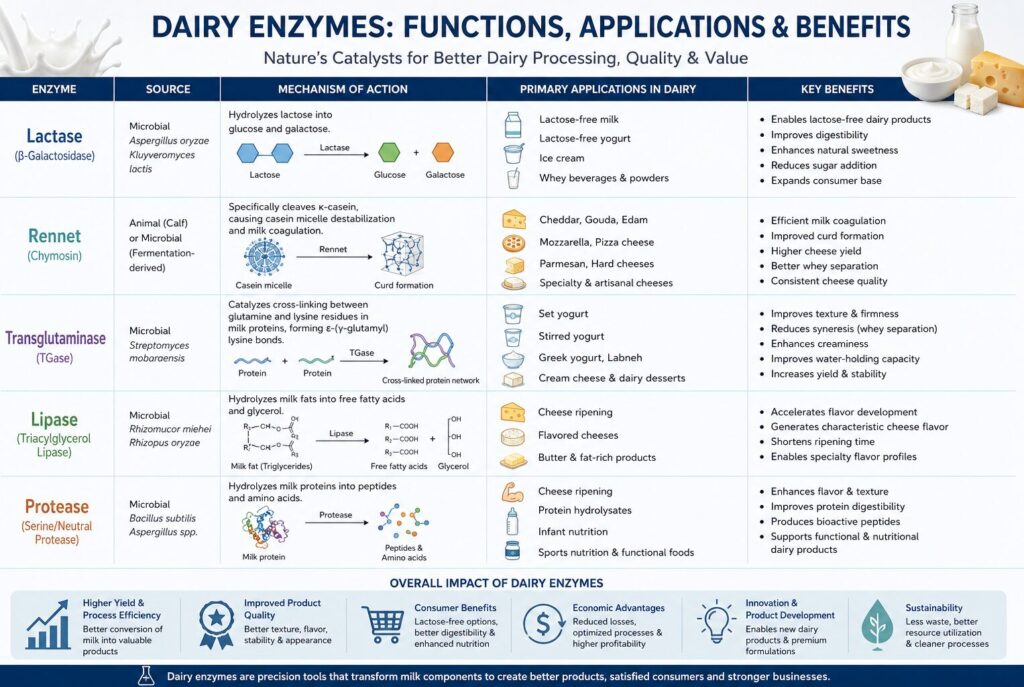
Major Dairy Enzymes at a Glance
Table 2: Major Dairy Enzymes and Their Functions
| Enzyme | Primary Function | Major Dairy Applications |
|---|---|---|
| Lactase | Hydrolyzes lactose into glucose and galactose | Lactose-free milk, yogurt, beverages |
| Rennet (Chymosin) | Coagulates casein proteins | Cheese production |
| Transglutaminase | Cross-links proteins | Yogurt, dairy desserts, cream cheese |
| Lipase | Hydrolyzes milk fats | Cheese flavor development |
| Protease | Hydrolyzes proteins | Cheese ripening, protein hydrolysates |
| Multi-Enzyme Blends | Combined functionality | Advanced dairy processing |
Each enzyme contributes differently to dairy processing, and selecting the right enzyme depends on product type, processing conditions, and desired functionality.
Lactase: The Enzyme Driving the Lactose-Free Dairy Revolution
Among all dairy enzymes, Lactase has emerged as one of the most commercially important. The rapid growth of lactose-free dairy products has transformed Lactase from a niche processing aid into a core enzyme used by dairy manufacturers worldwide.
Lactose is the primary carbohydrate naturally present in milk. However, many consumers lack sufficient levels of the enzyme lactase in their digestive systems, resulting in lactose intolerance. This can cause discomfort after consuming traditional dairy products.
Industrial Lactase solves this challenge by hydrolyzing lactose into two simpler sugars: glucose and galactose.
Because these sugars are easier to digest and naturally sweeter than lactose, Lactase offers multiple benefits beyond lactose reduction alone.
Benefits of Lactase in Dairy Processing
- Production of lactose-free dairy products
- Improved digestibility
- Enhanced natural sweetness
- Potential reduction in added sugar requirements
- Improved consumer acceptance
- Access to premium product categories
Applications of Lactase
Lactose-Free Milk
The largest application of Lactase is the production of lactose-free milk. By converting lactose before product packaging, manufacturers can offer milk products suitable for lactose-sensitive consumers without significantly altering taste or nutritional value.
Yogurt and Fermented Dairy Products
Lactase enables production of lactose-free yogurt and fermented dairy products while maintaining desirable sensory characteristics.
Ice Cream
In frozen dairy products, Lactase can help reduce lactose crystallization and improve product smoothness.
Whey Processing
Lactase is increasingly used in whey-based beverages and dairy ingredients, improving digestibility and expanding market opportunities.
Table 3: Common Lactase Applications
| Product Category | Primary Benefit |
|---|---|
| Milk | Lactose hydrolysis |
| Yogurt | Improved digestibility |
| Ice Cream | Reduced lactose crystallization |
| Dairy Beverages | Enhanced sweetness |
| Whey Products | Improved consumer tolerance |
Why Lactose-Free Dairy Continues to Grow
The lactose-free dairy category continues to expand globally due to increasing consumer awareness, growing demand for digestive wellness products, and broader interest in functional nutrition.
For dairy manufacturers, lactose-free products often command premium pricing while utilizing largely the same manufacturing infrastructure. This makes Lactase one of the most commercially valuable enzymes available to dairy processors today.
Rennet: The Foundation of Modern Cheese Manufacturing
Few enzymes have had a greater impact on dairy processing than Rennet.
For centuries, cheesemakers have relied on Rennet to transform liquid milk into curd. Today, Rennet remains one of the most important enzymes used in industrial cheese production.
Rennet contains chymosin, an enzyme that specifically acts on κ-casein, a protein responsible for stabilizing casein micelles within milk. When κ-casein is cleaved, the micelles become destabilized and begin to aggregate, leading to gel formation and curd development.
This controlled coagulation process forms the foundation of cheese production.
Benefits of Rennet
- Efficient milk coagulation
- Improved curd formation
- Enhanced protein retention
- Better whey separation
- Consistent cheese quality
- Improved cheese yield
Applications of Rennet in Cheese Manufacturing
Cheddar Cheese
Rennet supports controlled coagulation and development of a consistent curd structure essential for Cheddar production.
Mozzarella
In Mozzarella production, Rennet contributes to curd elasticity and stretching characteristics critical for final product performance.
Gouda and Semi-Hard Cheeses
Rennet helps maintain moisture balance and texture consistency in semi-hard cheese varieties.
Specialty Cheese Production
Different Rennet systems can be selected to support unique processing requirements and product characteristics.
Table 4: Rennet Applications in Cheese Production
| Cheese Type | Key Benefit |
|---|---|
| Cheddar | Consistent coagulation |
| Mozzarella | Elastic curd development |
| Gouda | Controlled moisture retention |
| Parmesan | Firm curd formation |
| Specialty Cheeses | Customized texture development |
How Rennet Improves Cheese Yield
Milk represents the largest raw material cost in cheese manufacturing.
As a result, even minor improvements in protein retention and curd formation can significantly affect profitability.
By improving coagulation efficiency and reducing losses of valuable milk solids into whey, Rennet helps maximize milk-to-cheese conversion efficiency and supports better overall manufacturing economics.
Transglutaminase: Improving Texture, Stability & Yield in Dairy Products
Among the various enzymes used in modern dairy processing, Transglutaminase occupies a unique position. While enzymes such as Lactase, Rennet, and Lipase primarily modify lactose, proteins, or fats through hydrolysis or coagulation reactions, Transglutaminase improves dairy products by strengthening protein networks.
Often referred to as a “protein cross-linking enzyme,” Transglutaminase catalyzes covalent bonds between glutamine and lysine residues naturally present in milk proteins. This reaction creates a stronger and more stable protein matrix, resulting in improved texture, enhanced water-holding capacity, better gel strength, and reduced serum separation.
As consumer demand shifts toward thicker yogurts, creamier dairy desserts, and premium dairy products, Transglutaminase has become an increasingly valuable processing tool.
Benefits of Transglutaminase in Dairy Processing
- Improved gel strength
- Reduced syneresis (whey separation)
- Enhanced creaminess and mouthfeel
- Increased water retention
- Improved product stability
- Better process consistency
- Potential yield improvement
Applications of Transglutaminase
Yogurt Manufacturing
One of the largest applications of Transglutaminase is yogurt production.
Consumers expect yogurt to maintain a smooth texture, desirable viscosity, and minimal whey separation throughout shelf life. However, maintaining these characteristics consistently can be challenging, particularly in low-fat or high-protein formulations.
By strengthening protein interactions, Transglutaminase improves yogurt structure and reduces the tendency for whey to separate during storage.
Greek Yogurt Production
Greek yogurt production involves significant whey removal, which can affect texture and yield.
Transglutaminase helps strengthen the protein network, improving water retention and contributing to a thicker, creamier product with enhanced stability.
Cream Cheese and Fresh Cheese
In fresh cheese applications, protein cross-linking can improve body, texture, spreadability, and moisture retention.
This contributes to a more consistent product while reducing processing variability.
Dairy Desserts
Transglutaminase is also used in dairy desserts where texture plays a critical role in consumer perception. Improved gel structure and stability help maintain product quality throughout storage and distribution.
Table 5: Common Applications of Transglutaminase in Dairy Processing
| Application | Primary Benefit |
|---|---|
| Set Yogurt | Improved gel strength |
| Stirred Yogurt | Better viscosity and texture |
| Greek Yogurt | Reduced syneresis |
| Cream Cheese | Improved body and spreadability |
| Dairy Desserts | Enhanced stability |
Solving One of Dairy’s Biggest Challenges: Syneresis
For yogurt manufacturers, whey separation is one of the most common quality complaints.
Visible serum formation can negatively affect consumer perception, even when the product remains safe and nutritious.
Transglutaminase helps address this challenge by creating a stronger protein network capable of retaining moisture more effectively. The result is improved product appearance, better mouthfeel, and greater shelf-life stability.
Lipase: Creating Rich Dairy Flavors and Premium Cheese Profiles
Texture may influence first impressions, but flavor ultimately determines whether consumers return to a product.
Lipase plays a critical role in developing the characteristic flavors associated with many premium cheeses and specialty dairy products.
Lipase functions by hydrolyzing milk fats into free fatty acids and other flavor-active compounds. These compounds contribute directly to the complex aroma and taste profiles that distinguish many cheese varieties.
Without controlled lipolysis, many cheeses would lack the depth and intensity of flavor consumers expect.
Benefits of Lipase
- Enhanced flavor development
- Faster flavor maturation
- Improved product differentiation
- Creation of specialty cheese profiles
- Potential reduction in ripening time
- Greater flavor consistency
Applications of Lipase
Cheese Ripening
Lipase is widely used during cheese maturation to accelerate flavor development and create characteristic cheese profiles.
The enzyme contributes to the formation of flavor compounds that develop throughout the aging process.
Specialty Cheese Manufacturing
Many traditional and specialty cheese varieties rely on controlled lipolysis to achieve their distinctive sensory characteristics.
Lipase helps manufacturers replicate these flavor profiles consistently.
Dairy Flavor Ingredients
Lipase is also used in the production of dairy flavor concentrates and specialty ingredients designed for use in processed foods.
Table 6: Lipase Applications in Dairy Products
| Application | Benefit |
|---|---|
| Cheese Ripening | Accelerated flavor development |
| Specialty Cheese | Characteristic flavor creation |
| Dairy Ingredients | Customized flavor profiles |
| Butter Products | Flavor enhancement |
The Economics of Flavor Development
Cheese flavor development traditionally requires time, and time carries cost.
Extended aging increases inventory holding costs, storage requirements, and capital tied up in product.
Strategic use of Lipase can help accelerate flavor development in certain cheese systems, allowing manufacturers to achieve target sensory profiles more efficiently while maintaining product quality.
Protease: Supporting Dairy Innovation and Protein Functionality
Proteases are among the most versatile enzymes used in the dairy industry.
Unlike Rennet, which performs highly specific coagulation functions, Proteases hydrolyze proteins into smaller peptides and amino acids. This controlled protein modification can dramatically influence digestibility, functionality, flavor development, and nutritional properties.
As demand grows for high-protein foods, functional nutrition products, and specialized dairy ingredients, Protease applications continue to expand.
Benefits of Protease
- Improved protein digestibility
- Accelerated cheese ripening
- Enhanced flavor development
- Production of protein hydrolysates
- Improved protein functionality
- Development of specialty nutritional ingredients
Applications of Protease
Cheese Ripening
Proteases contribute to the breakdown of proteins during cheese maturation.
This process generates peptides and amino acids that influence both texture and flavor development.
Dairy Protein Hydrolysates
Protein hydrolysates are increasingly used in nutritional products due to their improved digestibility and functional characteristics.
Proteases enable controlled hydrolysis to achieve desired peptide profiles.
Sports Nutrition Ingredients
The growing sports nutrition sector has created strong demand for high-quality protein ingredients.
Proteases help manufacturers develop protein products with improved digestibility and functionality.
Infant Nutrition Applications
Controlled protein hydrolysis is also important in specialized infant nutrition formulations where specific functional and nutritional characteristics are required.
Table 7: Protease Applications in Dairy Processing
| Application | Primary Benefit |
|---|---|
| Cheese Ripening | Flavor and texture development |
| Protein Hydrolysates | Improved digestibility |
| Sports Nutrition | Functional protein ingredients |
| Infant Nutrition | Controlled protein modification |
| Dairy Ingredients | Enhanced functionality |
Supporting the Growth of High-Protein Dairy Products
Consumer interest in protein-rich foods continues to grow globally.
Whether producing protein beverages, nutritional supplements, dairy protein concentrates, or specialized dairy ingredients, manufacturers increasingly rely on enzyme technology to optimize protein functionality and consumer acceptance.
Proteases play an important role in enabling these innovations.
Common Dairy Processing Challenges and Enzyme Solutions
While dairy enzymes perform different functions, they often address common production challenges faced by manufacturers.
Table 8: Dairy Processing Challenges and Recommended Enzyme Solutions
| Processing Challenge | Recommended Enzyme |
|---|---|
| Lactose Intolerance | Lactase |
| Poor Cheese Yield | Rennet |
| Weak Curd Formation | Rennet |
| Whey Separation | Transglutaminase |
| Weak Yogurt Texture | Transglutaminase |
| Slow Flavor Development | Lipase |
| Protein Modification Requirements | Protease |
| Multiple Processing Objectives | Multi-Enzyme Blends |
Selecting the appropriate enzyme system depends on product objectives, processing conditions, milk composition, and manufacturing goals.
In many cases, enzyme selection should be approached as part of an overall process optimization strategy rather than as an isolated ingredient decision.
Dairy Enzymes and Processing Economics
While enzymes are often evaluated based on their technical performance, their true value is measured by their impact on manufacturing economics.
For many dairy processors, even a small improvement in yield or reduction in product losses can translate into significant annual savings.
Table 9: How Dairy Enzymes Create Economic Value
| Operational Area | Potential Benefit |
|---|---|
| Cheese Yield | More product from the same milk volume |
| Whey Reduction | Lower product losses |
| Lactose-Free Products | Higher-value product offerings |
| Flavor Development | Premium product positioning |
| Texture Improvement | Reduced complaints and rejects |
| Process Consistency | Improved manufacturing reliability |
| Product Innovation | Access to new markets |
The economic impact of enzymes extends beyond direct production gains. They also support premium product development, improved consumer satisfaction, and greater manufacturing flexibility.
Future Trends in Dairy Enzymes
Several long-term trends continue to drive adoption of enzyme technology throughout the dairy industry.
Expansion of Lactose-Free Dairy
Consumer awareness of lactose intolerance continues to increase globally, supporting sustained growth in lactose-free milk, yogurt, and dairy beverages.
Growth of High-Protein Products
Protein-rich dairy products require improved protein functionality, stability, and digestibility—areas where enzyme technology can provide significant benefits.
Premium Cheese Production
Specialty and value-added cheese markets continue to expand, increasing demand for enzymes that support yield optimization, ripening, and flavor development.
Functional Dairy Nutrition
Consumers increasingly seek products that offer nutritional benefits beyond basic nutrition, creating new opportunities for enzyme-enabled dairy innovation.
Sustainable Dairy Processing
Manufacturers are under pressure to maximize milk utilization, reduce waste streams, and improve processing efficiency. Enzymes support these goals by helping processors extract greater value from existing raw materials.
As these trends continue, dairy enzymes will play an increasingly important role in future dairy innovation.
Final Thoughts
Modern dairy processing is increasingly focused on improving yield, enhancing texture, accelerating flavor development, improving digestibility, and maximizing manufacturing efficiency.
Dairy enzymes provide targeted solutions that help manufacturers achieve these objectives while supporting product innovation and profitability.
From Lactase for lactose-free dairy products to Rennet for cheese manufacturing, Transglutaminase for texture optimization, Lipase for flavor development, and Protease for protein modification, enzyme technology has become a cornerstone of modern dairy processing.
As consumer expectations continue to evolve and dairy manufacturers pursue greater efficiency and differentiation, the strategic use of enzymes will remain a key driver of success across the industry.
Catalex Bio – Dairy Enzyme Manufacturer & Supplier
Catalex Bio supplies enzyme solutions for:
✓ Lactose-Free Milk Production
✓ Cheese Manufacturing
✓ Yogurt Processing
✓ Dairy Flavor Development
✓ Protein Modification Applications
✓ High-Protein Dairy Products
✓ Dairy Ingredient Processing
✓ Customized Multi-Enzyme Dairy Solutions
Our dairy enzyme portfolio includes:
- Lactase
- Rennet
- Transglutaminase
- Lipase
- Protease
- Customized Multi-Enzyme Blends
In addition to enzyme supply, we provide:
- Technical Consultation
- Dosage Optimization Support
- Trial and Sample Support
- COA, TDS & MSDS Documentation
- Commercial Supply Support
- Global Export Assistance
Looking for a Reliable Dairy Enzyme Supplier?
Whether you manufacture cheese, yogurt, lactose-free milk, dairy beverages, dairy ingredients, protein products, or specialty dairy formulations, Catalex Bio can help identify the right enzyme solution for your processing objectives.
Contact our team today for technical discussions, enzyme recommendations, dosage guidance, trial samples, and commercial quotations.