Introduction
High Fructose Corn Syrup (HFCS) is one of the most widely used sweeteners in the global food and beverage industry. From soft drinks and fruit beverages to bakery products, confectionery, dairy applications, and processed foods, HFCS offers an attractive combination of sweetness, functionality, and cost efficiency.
As demand for sweeteners continues to grow, manufacturers are under increasing pressure to maximize production efficiency while maintaining consistent product quality and controlling operating costs. One of the most important factors influencing the economics of HFCS manufacturing is fructose yield.
Even small improvements in glucose-to-fructose conversion can significantly impact product value, plant throughput, and overall profitability.
For industrial starch processors, a common question is:
How can fructose yield be increased while maintaining stable reactor productivity, long enzyme life, and continuous operation?
The answer lies largely in the effective use of immobilized glucose isomerase, the enzyme responsible for converting glucose into fructose during HFCS production.
Catalex Bio is a Glucose Isomerase Enzyme Manufacturer and Glucose Isomerase Enzyme Supplier providing immobilized glucose isomerase solutions for industrial HFCS production, fructose syrup manufacturing, and starch processing applications. Our enzyme solutions are designed to support reliable fructose conversion, stable reactor performance, and long operational campaigns in continuous production systems.
This article explores how immobilized glucose isomerase improves fructose yield, enhances reactor productivity, and contributes to more efficient HFCS manufacturing.
Why Fructose Yield Matters in HFCS Production
In HFCS production, fructose yield is one of the most important performance indicators. Since fructose is sweeter than glucose, increasing fructose concentration improves the value and functionality of the final syrup.
The economics of large-scale sweetener production are heavily influenced by conversion efficiency. The more glucose converted into fructose, the greater the value generated from the same quantity of starch-derived feedstock.
Table 1: Why Fructose Yield Matters
| Factor | Impact on Production |
|---|---|
| Higher Fructose Content | Increased product value |
| Improved Sweetness Profile | Better formulation flexibility |
| Better Feedstock Utilization | Improved process efficiency |
| Increased Plant Throughput | Higher productivity |
| Stable Product Quality | Reduced variability |
| Better Production Economics | Improved profitability |
Because HFCS plants operate continuously and at large volumes, even modest improvements in fructose yield can generate significant annual economic benefits.
The Role of Glucose Isomerase in HFCS Manufacturing
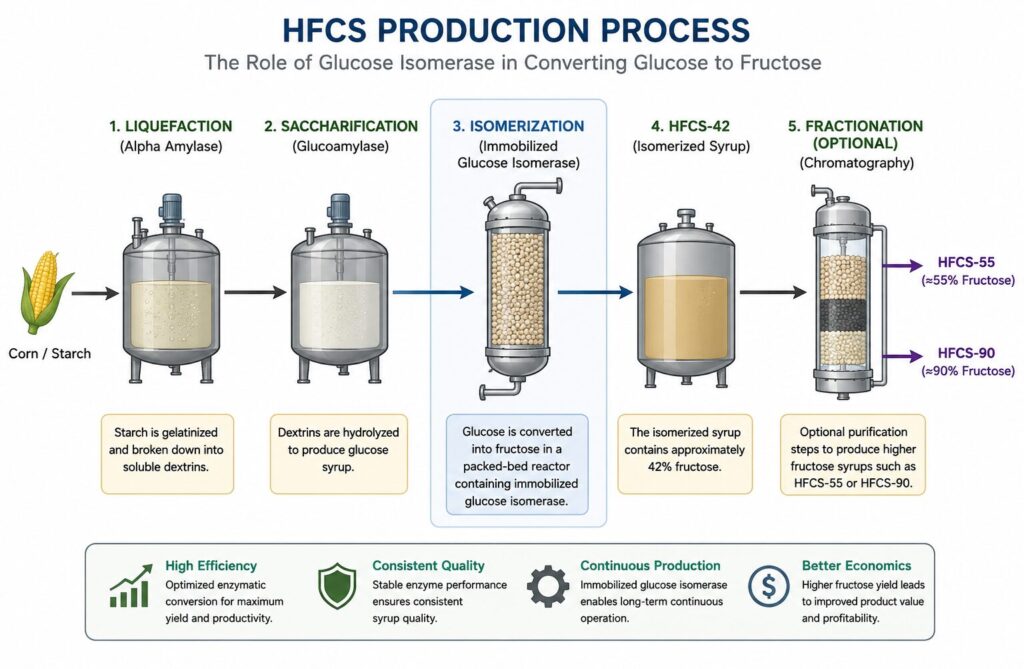
HFCS production involves a sequence of enzymatic processing steps that convert starch into fructose-rich syrup.
The overall process typically follows:
Starch → Liquefaction → Saccharification → Isomerization → HFCS
Table 2: Enzymes Used During HFCS Production
| Process Step | Main Enzyme | Function |
|---|---|---|
| Liquefaction | Alpha Amylase | Breaks starch into dextrins |
| Saccharification | Glucoamylase | Converts dextrins into glucose |
| Isomerization | Glucose Isomerase | Converts glucose into fructose |
Glucose isomerase is responsible for the most value-generating stage of HFCS production. During isomerization, glucose molecules are converted into fructose, increasing the sweetness and market value of the syrup.
Understanding Immobilized Glucose Isomerase Technology
While glucose isomerase can theoretically be used in free form, commercial HFCS plants almost exclusively utilize immobilized enzyme systems.
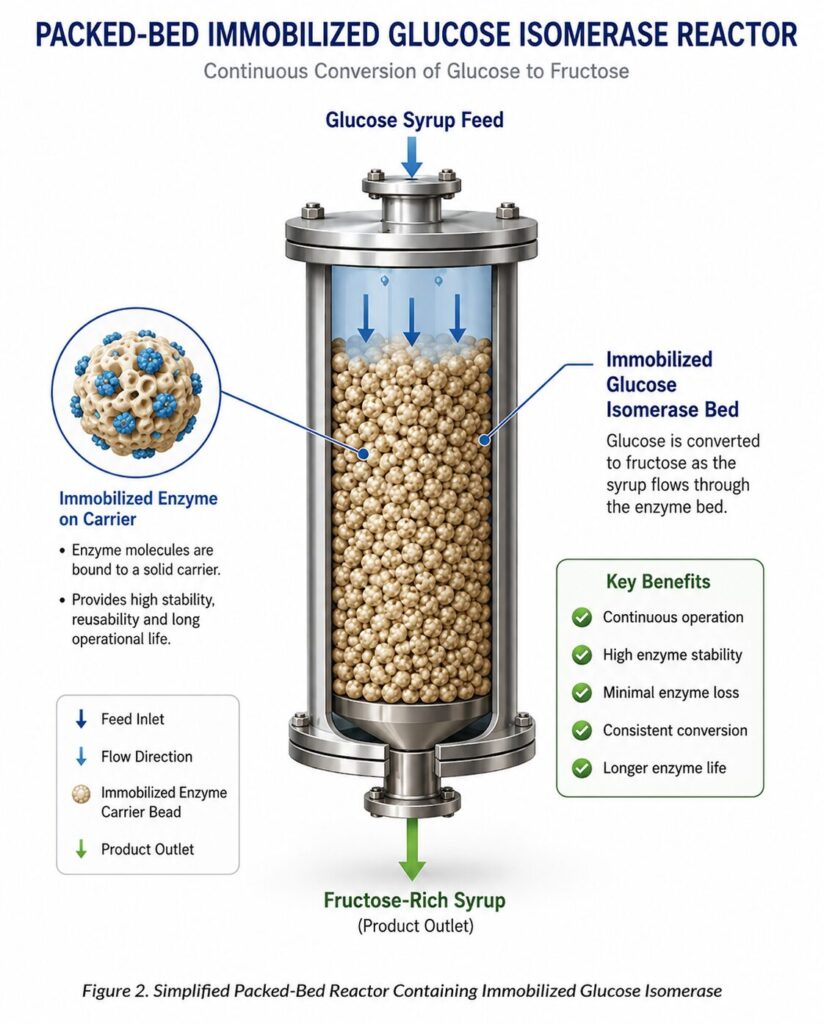
Immobilization involves attaching enzyme molecules to specially engineered carrier materials. These immobilized particles are then packed into industrial reactors through which glucose syrup continuously flows.
The enzyme remains inside the reactor while the syrup passes through and undergoes conversion.
Table 3: Free vs Immobilized Glucose Isomerase
| Parameter | Free Enzyme | Immobilized Enzyme |
|---|---|---|
| Enzyme Recovery | Difficult | Easy |
| Enzyme Reuse | Limited | Extensive |
| Continuous Operation | Difficult | Excellent |
| Product Separation | Additional Processing Required | Simplified |
| Operational Stability | Lower | Higher |
| Enzyme Loss | Higher | Minimal |
| Industrial Suitability | Limited | Industry Standard |
The development of immobilized glucose isomerase transformed HFCS manufacturing by enabling highly efficient continuous production systems.
How Immobilized Glucose Isomerase Improves Fructose Yield
The advantages of immobilized glucose isomerase extend beyond enzyme recovery. The technology directly contributes to more stable and efficient fructose production.
Stable Enzyme Activity
Immobilization helps protect enzyme structure and maintain catalytic activity under industrial operating conditions. Stable enzyme activity supports consistent fructose conversion throughout long production campaigns.
Improved Substrate-Enzyme Contact
In packed-bed reactors, glucose syrup continuously flows through a dense bed of immobilized enzyme particles. This arrangement promotes efficient interaction between glucose molecules and enzyme active sites, improving overall conversion efficiency.
Controlled Residence Time
Residence time refers to the duration that syrup remains inside the reactor. By carefully controlling flow rates and reactor volume, manufacturers can optimize contact time between substrate and enzyme to maximize fructose conversion.
Reduced Enzyme Washout
Unlike free enzyme systems, immobilized glucose isomerase remains confined within the reactor. This minimizes enzyme loss and supports stable long-term operation.
Consistent Conversion Performance
Because enzyme concentration remains stable within the reactor, immobilized systems help maintain more uniform fructose production and reduce process variability.
Why Fructose Conversion Is Not 100%
A common misconception is that all glucose can be converted into fructose.
In reality, the glucose isomerase reaction is reversible and governed by chemical equilibrium:
Glucose ⇌ Fructose
As fructose concentration increases, the reaction gradually approaches equilibrium and conversion slows. Under typical industrial operating conditions, this equilibrium limits the amount of fructose that can be produced in a single isomerization step.
This is one reason why HFCS-42 is commonly produced directly from isomerization reactors.
For higher-fructose products such as HFCS-55, additional fractionation and enrichment processes are often employed downstream.
Understanding this equilibrium limitation is important because yield improvements are generally achieved through process optimization and reactor performance improvements rather than simply increasing enzyme dosage.
Key Factors Affecting Fructose Yield
Several operating variables influence conversion efficiency and final fructose concentration.
Table 4: Key Factors Affecting Fructose Yield
| Parameter | Influence on Conversion |
|---|---|
| Temperature | High |
| pH | High |
| Residence Time | High |
| Flow Rate | High |
| Glucose Concentration | Moderate to High |
| Reactor Loading | Moderate |
| Immobilization Quality | High |
| Feed Syrup Quality | Moderate |
Maintaining optimal operating conditions helps maximize conversion while preserving enzyme stability and longevity.
Reactor Performance and Continuous Production Efficiency
Modern HFCS plants rely heavily on packed-bed reactor technology.
Table 5: Reactor Characteristics Influencing Productivity
| Reactor Factor | Impact |
|---|---|
| Uniform Flow Distribution | Consistent Conversion |
| Stable Pressure Profile | Reliable Operation |
| Effective Temperature Control | Improved Enzyme Stability |
| Reduced Channeling | Better Reactor Utilization |
| Controlled Residence Time | Improved Fructose Yield |
Uniform flow distribution is particularly important because channeling can reduce effective utilization of the enzyme bed and lower overall conversion efficiency.
Well-designed packed-bed reactors help ensure stable operation and long-term productivity.
Common Causes of Reduced Fructose Yield
Even well-operated facilities may experience declining conversion performance over time.
Table 6: Common Causes of Reduced Fructose Yield
| Cause | Potential Effect |
|---|---|
| Enzyme Deactivation | Reduced Conversion |
| Temperature Fluctuations | Activity Loss |
| Poor Flow Distribution | Lower Reactor Efficiency |
| Syrup Impurities | Reduced Enzyme Stability |
| Excessive Flow Rate | Insufficient Residence Time |
| Reactor Channeling | Uneven Conversion |
Understanding these factors helps manufacturers maintain stable reactor performance and maximize enzyme productivity.
Economic Benefits of High-Performance Immobilized Glucose Isomerase
The benefits of improved fructose yield extend throughout the manufacturing process.
Table 7: Economic Benefits of Improved Conversion Performance
| Benefit | Business Impact |
|---|---|
| Higher Fructose Yield | Increased Product Value |
| Longer Enzyme Life | Reduced Replacement Costs |
| Continuous Operation | Higher Throughput |
| Reduced Downtime | Improved Productivity |
| Better Reactor Utilization | Increased Return on Assets |
| Stable Production | Consistent Product Quality |
For large-scale starch processors, these benefits can create substantial long-term improvements in operational efficiency and profitability.
Choosing a Reliable Glucose Isomerase Enzyme Supplier
The performance of an immobilized glucose isomerase system depends not only on reactor operation but also on enzyme quality and supplier expertise.
When evaluating a Glucose Isomerase Enzyme Manufacturer or Glucose Isomerase Enzyme Supplier, important considerations include:
- Consistent product quality
- Reliable supply continuity
- Technical Data Sheets (TDS)
- Certificate of Analysis (COA)
- Technical support and troubleshooting
- Application guidance
- Batch-to-batch consistency
- Global export capabilities
- Regulatory and quality documentation
A reliable supplier should support customers throughout the implementation and production lifecycle rather than simply supplying the enzyme itself.
Conclusion
Improving fructose yield remains a key objective for modern HFCS manufacturers seeking higher productivity, better feedstock utilization, and stronger production economics.
Immobilized glucose isomerase plays a central role in achieving these goals by enabling continuous operation, stable enzyme performance, reduced enzyme loss, and efficient glucose-to-fructose conversion.
Factors such as reactor design, temperature control, pH management, residence time, syrup quality, and enzyme stability all contribute to successful HFCS production. When combined with high-performance immobilized glucose isomerase systems, these factors help manufacturers achieve reliable fructose conversion and long-term operational efficiency.
Catalex Bio is a Glucose Isomerase Enzyme Manufacturer and Glucose Isomerase Enzyme Supplier providing immobilized glucose isomerase solutions for HFCS production, fructose syrup manufacturing, and industrial starch processing applications.
Our team supports customers with enzyme selection, technical documentation, application guidance, and reliable industrial supply to help optimize fructose yield and reactor performance.
Contact Catalex Bio
If you are evaluating immobilized glucose isomerase for HFCS production or looking to improve fructose yield in an existing process, contact Catalex Bio to discuss your application requirements, technical specifications, and enzyme sourcing needs.