
1. Introduction
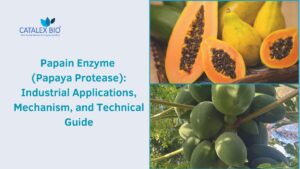
Enzymes have revolutionized industrial biotechnology by offering clean, efficient, and sustainable alternatives to conventional chemical processing. Among plant-derived proteases, Papain—a cysteine protease extracted from the latex of unripe Carica papaya fruit—holds a distinguished place. It is often referred to as Papaya Protease and is renowned for its broad substrate specificity, stability over a wide pH range, and ability to catalyze reactions under mild, eco-friendly conditions.
Papain (EC 3.4.22.2) belongs to the cysteine protease family, the same family as bromelain, and functions by hydrolyzing peptide bonds in proteins. It exhibits both endopeptidase and exopeptidase activity, making it highly versatile for partial or complete hydrolysis of complex proteins. This property has made papain invaluable across industries ranging from food processing and pharmaceuticals to cosmetics, textiles, and leather.
Unlike microbial proteases, papain’s natural plant origin appeals strongly to modern clean-label and vegan trends. It is biodegradable, non-toxic, and compatible with biological systems—ideal for processes demanding both performance and consumer safety. Its acceptance in food, nutraceutical, and cosmetic sectors further underscores its reputation as a “gentle yet powerful” biocatalyst.
At Catalex Bio, as a trusted papain enzyme manufacturer and supplier, we provide high-quality Papain enzyme sourced from the latex of unripe papaya fruits and processed under stringent quality controls. Our papain is available in multiple grades—food, pharmaceutical, and industrial—standardized by activity (TU, CDU, or GDU), ensuring consistency, traceability, and technical support for global customers.
This comprehensive guide covers:
- The discovery and history of Papain
- Its structure and catalytic mechanism
- Sources and commercial forms
- Detailed industrial applications across sectors
- Comparison with fungal and bacterial proteases
- Units of activity and assay methods
- User guidance for buyers and formulators
- Future trends and innovations in papain biotechnology
By the end of this article, you’ll understand why papain continues to be one of the most valuable and sustainable natural proteases in modern industry.
2. History and Discovery of Papain
The story of papain dates back more than a century, with its roots intertwined with traditional medicine and early biochemical exploration.
Early Observations (19th Century):
Local communities in tropical regions had long used papaya latex to tenderize meat and treat digestive issues. Scientists later traced this activity to a specific enzyme present in the milky sap of unripe papaya fruit.
Discovery and Isolation:
In 1879, the enzyme was first identified and named Papain after its botanical source, Carica papaya. By the early 20th century, researchers had successfully extracted and characterized papain, identifying it as a cysteine protease — an enzyme dependent on a reactive cysteine residue in its active site to cleave peptide bonds.
Industrial Development (Mid-20th Century):
With the advent of industrial biotechnology in the 1950s and 1960s, papain found growing applications in food processing, pharmaceuticals, and leather industries. Its ability to hydrolyze complex proteins under mild conditions made it a favored alternative to animal proteases like pepsin and trypsin.
Present Day:
Modern extraction, purification, and stabilization techniques have refined papain into a standardized, high-activity commercial enzyme, available in powder, granule, or liquid forms. Its natural, GRAS (Generally Recognized as Safe) status continues to make it an enzyme of choice for industries seeking vegan, sustainable, and clean-label processing aids.
3. Structure and Mechanism of Action of Papain
Papain belongs to the papain-like cysteine protease family (Clan CA, family C1A)—a well-characterized group of proteases that includes bromelain and ficin. These enzymes share a conserved catalytic dyad consisting of a cysteine and a histidine residue in the active site.
3.1 Structural Characteristics
- Molecular Weight: ~23.4 kDa
- Isoelectric Point (pI): ~8.7
- Catalytic Residues: Cys-25 and His-159 form the catalytic dyad essential for peptide bond cleavage.
- Stabilizing Residues: Asn-175 contributes to hydrogen bonding during catalysis.
- Structure Type: Globular protein containing α-helices and β-sheets forming a cleft-shaped active site.
- Substrate Specificity: Broad—acts on a variety of peptide bonds involving basic or bulky residues such as arginine, lysine, or phenylalanine.
3.2 Mechanism of Action
Papain catalyzes hydrolysis of peptide bonds via nucleophilic attack by the thiol group (-SH) of cysteine:
- Substrate Binding: Protein substrate enters the enzyme’s cleft.
- Nucleophilic Attack: The cysteine thiol group attacks the carbonyl carbon of the peptide bond.
- Formation of a Covalent Intermediate: A tetrahedral acyl-enzyme complex is formed.
- Cleavage and Release: The peptide bond is broken, releasing one peptide fragment.
- Deacylation: Water molecule hydrolyzes the intermediate, regenerating the enzyme.
This mechanism allows papain to act efficiently under mild conditions and to hydrolyze both native and denatured proteins, which is crucial for applications like tenderization, hydrolysis, and exfoliation.
3.3 Functional Properties
- Optimal pH: 5.0–7.0 (active between 3.0–10.0).
- Optimal Temperature: 50–65 °C.
- Inhibitors: Inactivated by cysteine protease inhibitors (e.g., E-64, iodoacetamide).
- Stabilizers: Reducing agents (cysteine, sodium metabisulfite) enhance activity.
- Form: Available as powder, granules, or stabilized liquid concentrate.
4. Sources of Papain
Papain is a natural plant enzyme derived from the latex of unripe papaya (Carica papaya) fruits, which contain the highest concentration of active enzyme. However, for industrial-scale production, careful selection of raw material, extraction methods, and purification steps are crucial to ensure consistent enzyme activity and stability.
4.1 Natural Plant Source – Papaya Latex
- Collection: Latex is obtained by scoring (making shallow incisions) on the surface of unripe papaya fruits. The milky sap exudes naturally and is collected in small trays or containers.
- Processing: The latex is immediately dried under controlled conditions—traditionally sun-dried but now often vacuum- or spray-dried—to preserve enzymatic activity.
- Yield & Composition: Dried latex typically contains 5–8% active papain, along with chymopapain, peptidases, and minor plant proteins.
- Sustainability Aspect: The process uses unripe fruits, often unsuitable for the fresh market, thereby adding value to agricultural by-products.
4.2 Commercial Production and Purification
- Crude Papain: Produced by drying latex and sieving into a powder. Used for meat tenderization, bating, and other bulk applications.
- Refined Papain: Further purified and standardized based on activity (in TU, CDU, or GDU). Used in food and pharmaceutical industries.
- Purification Techniques: Include solvent precipitation, ultrafiltration, ion-exchange chromatography, and crystallization.
- Grades Available:
- Food Grade: Used in meat, brewing, baking, and beverages.
- Pharmaceutical Grade: Used in digestive formulations, wound healing, and anti-inflammatory supplements.
- Industrial Grade: Applied in textiles, leather, detergents, and cosmetics.
4.3 Biotechnological and Recombinant Production
- Modern biotechnology has enabled recombinant expression of papain genes in microbial hosts like Escherichia coli and Pichia pastoris.
- This approach ensures consistent enzyme quality, reduces dependency on papaya crops, and allows for customization of enzyme activity and stability.
- Recombinant papain is gaining traction for medical and analytical applications, where purity and reproducibility are critical.
5. Industrial Applications of Papain
Papain’s broad substrate specificity, ability to function under mild pH and temperature, and natural origin make it one of the most commercially versatile proteolytic enzymes. It has applications across food, pharmaceuticals, cosmetics, leather, textile, feed, and detergent industries.
Below is a sector-wise detailed overview.
5.1 Food Industry Applications
A. Meat Tenderization
- Mechanism: Papain hydrolyzes collagen and myofibrillar proteins (actin, myosin), reducing toughness and enhancing texture.
- Application:
- Used as powder sprinkle, injection marinade, or dip solution.
- Dosage typically 0.05–0.3% w/w or 100–600 TU/kg meat, depending on cut toughness.
- Benefits:
- Improves chewability and juiciness.
- Retains water-binding capacity.
- Reduces cooking loss and improves flavor release.
- Comparison: Compared to bacterial proteases, papain acts more gently, preventing “mushy” textures or off-flavors.
B. Production of Protein Hydrolysates
- Purpose: To generate low-molecular-weight peptides for use in infant foods, sports nutrition, and flavor enhancers.
- Substrates: Casein, soy protein, wheat gluten, fish protein.
- Advantages:
- Produces mild-tasting, hypoallergenic peptides.
- Enhances digestibility.
- Retains amino acid balance.
- Conditions: pH 6.0–7.0, 55–60 °C; enzyme dose ~0.1–0.5% (w/w protein).
C. Brewing and Beverage Clarification
- Application: Added to beer or fruit juices to hydrolyze haze-forming proteins.
- Dosage: 5–10 TU/L beer or 10–100 ppm in juice.
- Effect:
- Prevents chill haze.
- Improves clarity and stability without affecting flavor.
- Note: Papain remains active even in slightly acidic beverage pH (~4.0–4.5), giving it an advantage over many microbial proteases.
D. Baking and Dough Improvement
- Mechanism: Papain partially modifies gluten structure, improving dough extensibility and machinability.
- Benefits:
- Enhances dough handling.
- Increases loaf volume and crumb softness.
- Improves shelf-life by retarding staling.
- Caution: Overuse may weaken dough excessively; proper dosing and enzyme activity calibration are critical.
E. Dairy and Flavor Industry
- Use: Hydrolysis of milk and whey proteins to produce bioactive peptides and flavor-enhancing compounds.
- Advantage: Papain provides smoother flavor profiles than alkaline proteases, which may generate bitterness.
5.2 Pharmaceutical and Healthcare Industry
A. Digestive Aid Formulations
- Form: Capsules, tablets, or blended digestive enzyme powders.
- Role: Hydrolyzes dietary proteins into peptides and amino acids, aiding digestion in individuals with low protease secretion or dyspepsia.
- Typical dose: 100–500 TU per capsule.
- Synergy: Often combined with amylase and lipase for complete digestion support.
B. Wound Debridement and Healing
- Function: Papain selectively digests necrotic tissue while sparing healthy cells.
- Application: Enzymatic debridement gels or creams (1–5% concentration).
- Clinical advantage: Promotes rapid wound cleaning and accelerates granulation tissue formation.
- Products: Papain–urea formulations are widely used in burn and ulcer care.
C. Anti-inflammatory and Analgesic Effects
- Mechanism: Papain modulates inflammatory mediators and supports fibrinolytic activity.
- Applications: Post-operative recovery, sinusitis, arthritis, trauma-related swelling.
- Form: Oral enzyme supplements (often combined with bromelain or trypsin).
D. Oncology and Immunomodulation (Emerging Area)
- Research Direction: Studies indicate papain may enhance immune modulation, improve drug absorption, and inhibit tumor cell adhesion.
- Status: Experimental, but promising in enzyme-based combination therapies.
5.3 Cosmetic and Personal Care Industry
A. Skin Exfoliation and Renewal
- Mechanism: Papain hydrolyzes keratin and corneocyte proteins in the stratum corneum.
- Applications:
- Enzyme peels, exfoliating masks, and facial cleansers (0.1–1%).
- Removes dead skin cells without mechanical abrasion.
- Advantages: Natural, non-irritating, suitable for sensitive skin.
- Synergy: Often paired with fruit acids (AHAs) for dual exfoliation.
B. Anti-Aging and Brightening Formulations
- Promotes cell turnover and reduces dullness.
- Supports smoother skin texture and even tone.
- Incorporated in serums, gels, and creams for daily use.
C. Hair Care Applications
- Mechanism: Hydrolyzes keratin proteins in the hair shaft to smoothen and soften.
- Use: 0.05–0.5% in shampoos or conditioners.
- Improves manageability and sheen while preventing buildup.
5.4 Leather and Textile Industry
A. Leather Bating and Dehairing
- Function: Removes non-collagenous proteins, scud, and unwanted residues after liming.
- Application: 0.1–0.5% (w/w of hides) at pH 6–7 and 40–50 °C.
- Advantages:
- Produces soft, fine-grained leather.
- Reduces use of harsh chemicals like sulfides.
- Environmentally safe disposal of effluents.
- Comparison: Papain provides milder bating compared to bacterial proteases, which are used for aggressive dehairing.
B. Textile Fiber Modification
- Function: Hydrolyzes protein-based impurities in wool and silk, enhancing softness and dye uptake.
- Use: 0.1–1% enzyme bath at 45–55 °C, near-neutral pH.
- Outcome: Improved luster and uniform dye penetration.
5.5 Detergent and Cleaning Industry
- Application: Component in biological detergents for stain removal.
- Function: Hydrolyzes protein-based stains such as blood, egg, or grass.
- Advantages:
- Effective at moderate washing temperatures (40–60 °C).
- Reduces need for strong alkaline chemicals.
- Compatible with enzyme blends containing amylase and lipase.
- Preferred Source: Bacterial proteases dominate the detergent market, but papain is used where mildness and biodegradability are prioritized (e.g., baby detergents or eco-brands).
5.6 Animal Feed
- Role: Improves digestibility of plant and animal proteins in feed formulations.
- Dosage: 100–1000 TU/kg feed; often used with amylases and cellulases.
- Benefits:
- Enhances amino acid availability.
- Improves growth performance and nutrient absorption.
- Reduces undigested protein waste in manure.
5.7 Biotechnology and Laboratory Use
- Use: Mild protease for cell dissociation in tissue culture—especially useful for neuronal and sensitive cell lines.
- Benefit: Gentle cleavage preserves cell surface receptors better than trypsin.
- Other Applications: Protein structure analysis, digestion of recombinant proteins, and sample preparation for mass spectrometry.
6. Fungal vs. Bacterial Proteases: Where Does Papain Fit?
Although papain is a plant-derived protease, industries often compare it with microbial proteases (from fungal or bacterial sources) when deciding which enzyme best suits their process. While all three share protein-hydrolyzing capability, their performance, cost, and application range differ significantly.
Below is a comparative overview that positions papain within the broader protease landscape.
6.1 Comparative Table: Papain vs. Fungal Protease vs. Bacterial Protease
| Parameter | Papain (Plant) | Fungal Protease | Bacterial Protease |
|---|---|---|---|
| Primary Source | Latex of Carica papaya (unripe fruit) | Aspergillus oryzae, A. niger | Bacillus subtilis, B. licheniformis |
| Enzyme Type | Cysteine protease | Mainly aspartic or neutral protease | Alkaline serine protease |
| Optimal pH | 5.5 – 7.0 (active range 3–10) | 4.0 – 7.0 | 8.0 – 11.0 |
| Optimal Temperature | 50 – 65 °C | 40 – 55 °C | 50 – 75 °C |
| Substrate Specificity | Broad (collagen, casein, gelatin, soy, keratin) | Mild, selective | Strong, non-selective |
| Stability | Moderate; deactivates with heat/oxidation | Stable in acidic range | Highly stable at alkaline and thermal conditions |
| Production Method | Extraction from papaya latex | Fermentation | Fermentation |
| Production Cost | Medium to high | Low | Very low |
| GRAS Status | Yes (FDA, EFSA, FSSAI) | Yes | Yes |
| Application Focus | Food, Pharma, Cosmetics | Food, Feed, Brewing | Detergent, Leather, Feed |
| Market Position | “Natural,” clean-label, gentle action | Cost-effective, mild industrial enzyme | Robust, high-efficiency industrial enzyme |
6.2 Key Observations
- Papain stands out for its natural origin and mild activity, ideal for food, healthcare, and cosmetic markets seeking plant-based, vegan, or organic ingredients.
- Fungal proteases are typically used for cost-sensitive applications (e.g., baking, soy hydrolysis, feed) due to their moderate pH range and fermentation scalability.
- Bacterial proteases dominate in detergents, leather, and animal feed, where high temperature and alkaline tolerance are critical.
6.3 Rule of Thumb for Industrial Use
| Condition / Industry | Preferred Enzyme Type |
|---|---|
| Acidic food processing (juices, soy, bakery) | Fungal protease |
| Harsh industrial environments (detergents, leather, feed) | Bacterial protease |
| Health-oriented, clean-label applications (food, pharma, cosmetics) | Papain (plant-based)6.3 Rule of Thumb for Industrial Use Condition / Industry Preferred Enzyme Type Acidic food processing (juices, soy, bakery) Fungal protease Harsh industrial environments (detergents, leather, feed) Bacterial protease Health-oriented, clean-label applications (food, pharma, cosmetics) Papain (plant-based) |
7. Units of Papain Activity Measurement
Like other proteases, papain’s potency is measured by its ability to hydrolyze proteins under standardized conditions. The choice of activity unit depends on the substrate and industry — for example, casein digestion for food-grade enzymes, or gelatin hydrolysis for nutraceuticals.
7.1 Common Activity Units for Papain
| Unit Name | Abbreviation | Definition | Typical Substrate | Common Applications |
|---|---|---|---|---|
| Tyrosine Units | TU or TU/mg | 1 TU = Amount of enzyme producing 1 µg tyrosine per minute under assay conditions | Casein | Most common across industries |
| Casein Digestion Units | CDU | Based on increase in absorbance (280 nm) due to peptides from casein | Casein | Food and industrial enzyme QC |
| Gelatin Digestion Units | GDU | 1 GDU = Enzyme that liberates 1 mg amino acids from gelatin per min | Gelatin | Used in dietary supplements (U.S.) |
| NF Units (National Formulary) | NF | Equivalent to GDU (U.S. pharmacopeia) | Gelatin | Pharmaceutical/nutraceutical labeling |
| Anson Units | AU | 1 AU = Enzyme liberating 1 µmol tyrosine per min from casein | Casein | R&D and high-precision analysis |
| FIP Units | FIP | Defined by the International Pharmaceutical Federation | Casein/Synthetic peptides | Pharma QC (rarely used for papain) |
7.2 Most Widely Used Industrial Unit
Tyrosine Units (TU/mg or TU/g) — The standard for commercial papain across food, pharmaceutical, and cosmetic industries.
Reasons:
- Simple, quantitative, and reproducible.
- Direct correlation with proteolytic performance.
- Internationally recognized and easy to cross-reference with CDU or GDU.
Typical Ranges:
- Crude Papain: 100–500 TU/mg
- Food-grade Papain: 200–600 TU/mg
- Pharma-grade Papain: 400–1000 TU/mg
- Nutraceutical GDU equivalent: 500–2000 GDU/g
8. How Papain Activity Is Measured (Assay Methods)
Since papain acts on a broad range of proteins, several assay methods are used depending on industry requirements. The most accepted methods involve casein or gelatin hydrolysis, where the enzyme’s action releases peptides or amino acids measurable via spectrophotometry.
8.1 Casein Digestion Assay (Tyrosine Unit / TU Method)
- Principle: Papain hydrolyzes casein into peptides and amino acids. Released tyrosine reacts with the Folin–Ciocalteu reagent, forming a blue color measurable at 660–750 nm.
- Reaction Conditions:
- pH: 6.5–7.0
- Temperature: 37 °C
- Incubation: 10–30 min
- Result Interpretation: Activity expressed as µg of tyrosine released per minute under defined conditions.
- Applications: Standard for quality control in food-grade and pharma-grade papain.
8.2 Gelatin Digestion Assay (GDU or NF Unit Method)
- Principle: Papain hydrolyzes gelatin into soluble peptides and amino acids.
- Measurement: The nitrogen or amino acid release rate is quantified to determine enzyme strength.
- Application: Primarily used for nutraceutical and dietary supplement enzymes marketed in GDU or NF units.
8.3 Azocasein or Chromogenic Substrate Assays
- Principle: Uses dyed casein (Azocasein) or chromogenic peptides. Papain’s activity releases colored fragments measurable at 440 nm.
- Advantages:
- Fast, convenient, and high-throughput.
- Suitable for R&D or enzyme stability studies.
- Limitation: Less representative of real protein hydrolysis.
8.4 Advanced Fluorometric or Synthetic Peptide Assays
- Used mainly in research laboratories or recombinant enzyme characterization.
- Employ fluorogenic substrates like Z-Phe-Arg-AMC to measure precise kinetic constants (Km, Vmax).
- Highly sensitive, ideal for purity and inhibition studies.
8.5 Practical Considerations
- Always specify assay type, pH, and temperature when declaring activity.
- Ensure reducing agents (e.g., cysteine) are included during testing, as papain requires the –SH group in reduced form.
- For commercial specifications, TU/mg or GDU/g with assay method reference is mandatory on technical datasheets and COA.
9. Practical Guidance for Enzyme Users
The success of papain in industrial operations depends on choosing the right grade, correct dosage, and proper handling practices. Below are key technical guidelines for formulation scientists, procurement teams, and process engineers.
9.1 Selecting the Right Grade
| Grade | Recommended Use | Form Available |
|---|---|---|
| Food Grade | Meat tenderization, protein hydrolysates, brewing, baking | Powder / granules |
| Pharmaceutical Grade | Digestive aids, wound care, anti-inflammatory formulations | Fine powder / capsule blend |
| Industrial Grade | Leather, textile, detergent, feed, cosmetics | Powder or stabilized liquid |
Catalex Bio supplies all three grades, standardized by activity and designed for specific applications with full documentation (COA, TDS, SDS, assay certificate).
9.2 Dosage Recommendations by Industry
| Industry/Application | Typical Dosage | Notes |
|---|---|---|
| Meat Tenderization | 0.05–0.3% (w/w of meat) or 100–600 TU/kg | Works best at 50–60 °C, pH 6–7 |
| Protein Hydrolysis (Food/Flavor) | 0.1–0.5% (w/w protein) | For mild hydrolysates with low bitterness |
| Beverage Clarification | 10–100 ppm | Prevents chill haze and sedimentation |
| Bakery and Dough | 0.01–0.05% (w/w flour) | Improves extensibility; avoid overuse |
| Digestive Supplements | 100–500 TU per tablet/capsule | Often blended with amylase and lipase |
| Wound Debridement | 1–5% enzyme cream | Used topically in medical formulations |
| Cosmetic Exfoliation | 0.1–1.0% | In peels, masks, serums |
| Leather Bating | 0.1–0.5% (w/w hides) | Replaces harsh bating chemicals |
| Textile Finishing | 0.1–1.0% | For wool/silk softening and dye uptake |
| Feed Supplementation | 100–1000 TU/kg feed | Enhances digestibility and protein uptake |
Note: Always standardize dosage based on enzyme activity (TU/mg) and substrate type. Pilot trials are recommended before scaling.
9.3 Handling and Storage
- Storage Temperature: Below 25 °C; avoid direct sunlight and moisture.
- Shelf Life: 18–24 months under sealed, cool, and dry conditions.
- Packaging: Available in 1 kg foil packs, 5 kg fiber drums, and 25 kg HDPE drums (customizable).
- Hygroscopic Nature: Keep container tightly closed; use desiccant pouches if needed.
- Formulation Stability: Addition of stabilizers (sugars, polyols, reducing agents) enhances long-term activity.
10. Future Outlook and Innovations
As industries move toward greener and more sustainable biocatalysts, papain is witnessing renewed interest as a versatile, next-generation enzyme. Advances in enzyme stabilization, recombinant expression, and formulation science are expanding its potential across food, pharma, and biotech sectors.
10.1 Recombinant and Engineered Papain
Modern biotechnology now allows papain gene expression in microbial systems like E. coli and Pichia pastoris, ensuring consistent yield, high purity, and reduced dependence on papaya crops. Recombinant papain is emerging in pharmaceuticals, wound-care, and research diagnostics where reproducibility is critical.
10.2 Immobilized and Cross-Linked Papain
Immobilization on carriers such as silica or chitosan improves enzyme stability, reusability, and operational efficiency. Industrial trials are underway for continuous bioreactors producing protein hydrolysates and peptide nutraceuticals.
10.3 Encapsulation and Nanotechnology
Encapsulated papain in liposomes or nanoparticles enhances shelf life, controlled release, and bioavailability, benefiting cosmetic and wound-care formulations.
10.4 Synergistic Enzyme Formulations
Papain is often blended with bromelain, trypsin, or amylase to achieve multifunctional activity—improving food texture, digestive efficacy, and wound debridement outcomes.
10.5 Role in Green Chemistry
Papain’s biodegradable and mild operating profile supports eco-friendly processes such as biopolymer modification, protein waste valorization, and enzymatic peptide synthesis, replacing harsher chemical catalysts.
10.6 Market and Regulatory Outlook
With its GRAS status, plant-based origin, and broad utility, papain continues to grow in nutraceuticals, cosmetics, and medical biotechnology. As industries adopt bio-based and cruelty-free ingredients, papain stands as a sustainable, high-performance protease for the future.
11. Conclusion
Papain has evolved from a simple tropical extract to a core enzyme of modern industrial biotechnology. Its ability to hydrolyze a wide range of proteins under mild, near-neutral conditions — combined with its natural, plant-based origin — makes it uniquely valuable in diverse sectors, from food and pharmaceuticals to cosmetics, leather, and biotechnology.
🔑 Key Takeaways:
- Natural Advantage: Plant-derived, vegan-friendly, and biodegradable — ideal for sustainable and clean-label processing.
- Functional Versatility: Effective across a broad pH range and temperature spectrum, suitable for multiple substrates.
- Balanced Activity: Gentler than bacterial proteases yet robust enough for industrial performance.
- Proven Safety: GRAS-approved and widely accepted for food and pharma use.
- Technical Flexibility: Available in multiple grades and activity levels, customizable for specific process requirements.
While bacterial proteases dominate alkaline and heavy-duty applications, and fungal proteases excel in cost-sensitive acidic environments, papain remains irreplaceable where natural origin, gentle action, and consumer perception matter most — especially in food, nutraceutical, and cosmetic industries.
As an experienced papain enzyme manufacturer and papain enzyme supplier, at Catalex Bio we combine deep enzyme expertise with modern bioprocessing capabilities to deliver high-purity, standardized Papain solutions tailored to industrial needs. From food-grade powders for tenderization and beverage clarification to pharmaceutical and cosmetic formulations, our enzymes are backed by rigorous quality control, global export experience, and full technical documentation.
We also offer custom enzyme blends, application support, and collaborative development for clients seeking high-performance, sustainable solutions.
Contact Catalex Bio today to request samples, technical data, or a tailored quote for papain based on your application and required activity level. Our papain enzymes are available with customizable activity levels for food processors, nutraceutical & pharmaceutical formulators, cosmetic manufacturers, textile and leather processors.
Pingback: Enzyme Buyer’s Glossary by Catalex Bio | Key Terms & Definitions
Pingback: Enzymes in Food Technology | Manufacturer & Supplier Insights by Catalex Bio
Pingback: Enzyme Market in India | Size, Applications, Growth & Industry Outlook
Pingback: Bromelain vs Papain: Differences, Uses & Industrial Applications