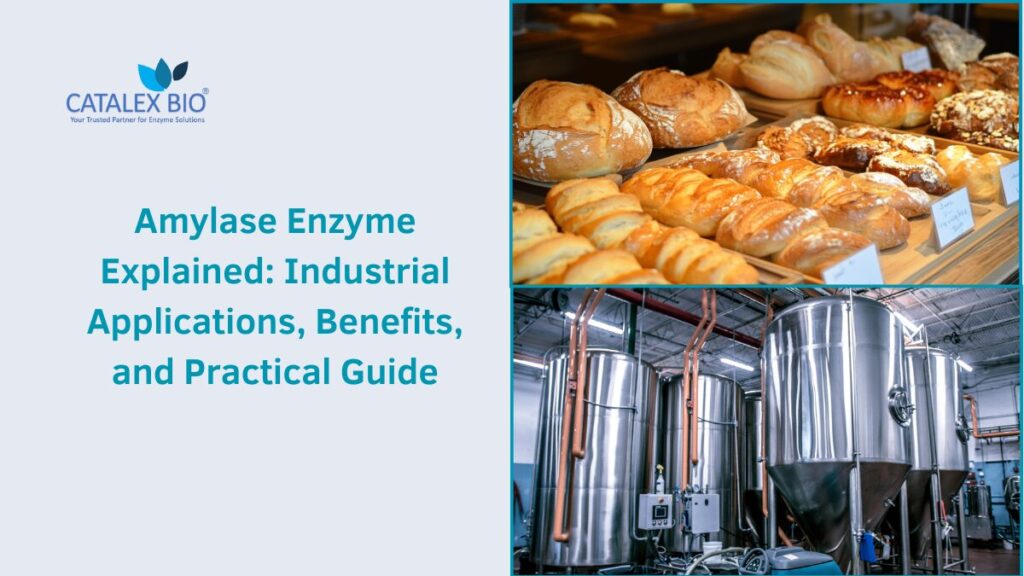

In industrial baking, consistency is everything.
The same product is expected to deliver the same texture, volume, and shelf life—batch after batch, day after day. But in reality, that’s not easy to achieve. Flour quality changes. Process conditions fluctuate. Equipment behaves differently under scale.
This is where bakery enzymes come in.
Baking enzymes are functional, protein-based processing aids that help improve dough handling, product quality, and shelf life. But in real-world manufacturing, they are far more than just ingredients—they are tools that help stabilize production, reduce variability, and solve practical challenges on the line.
From bread and biscuits to roti and clean-label formulations, enzymes have become essential for modern bakery operations.
At Catalex Bio, we work closely with industrial bakeries to develop enzyme systems tailored to specific production conditions—helping manufacturers move from reactive adjustments to controlled, consistent processes.
👉 Explore our full range of solutions: https://catalexbio.com/bakery-enzymes/
Why Baking Enzymes Have Become Essential in Modern Production
Industrial baking is not just about following a recipe—it’s about maintaining control across variables that constantly change.
As production scales, small inconsistencies can quickly become major issues. Enzymes act as a stabilizing factor, helping maintain performance even when conditions are less than ideal.
1. Managing Inconsistent Dough Performance
One of the most common challenges in baking is inconsistency in dough behavior.
Flour varies due to:
- Wheat origin
- Seasonal differences
- Milling variations
The result?
Dough that feels:
- Tight one day
- Sticky the next
- Weak under certain conditions
Instead of constantly adjusting formulations or process parameters, enzymes help bring consistency by modifying how dough components interact.
2. Extending Shelf Life Without Compromising Quality
Shelf life is not just a technical parameter—it directly impacts customer satisfaction and product returns.
Bread that becomes firm or dry too quickly loses its appeal.
Anti-staling enzymes, particularly Maltogenic Amylase, help slow down this process by modifying starch behavior. This allows products to retain softness for longer without relying heavily on preservatives.
3. Reducing Dependence on Chemical Additives
Traditional baking systems often rely on:
- Emulsifiers
- Oxidizing agents
- Chemical improvers
However, with increasing demand for clean-label products, manufacturers are looking for alternatives.
Enzymes offer a way to achieve similar functional outcomes through natural processing mechanisms, making them an important tool for cleaner formulations.
4. Improving Cost Efficiency
Production inefficiencies often go unnoticed until they begin affecting margins.
These may include:
- Lower product yield
- Higher rejection rates
- Inconsistent output
By improving process stability and reducing variability, enzyme systems contribute directly to better efficiency and cost control.
How Baking Enzymes Work
At their core, baking enzymes act on the main components of flour during different stages of processing.
Simple Mechanism Overview
- Starch → Sugars
Supports fermentation, improves gas production, and enhances crust color - Proteins → Dough Structure
Controls elasticity, strength, and extensibility of the dough - Lipids → Stability & Texture
Contributes to crumb softness and structural integrity
These transformations happen during mixing, fermentation, and baking. While invisible to the eye, they have a direct and measurable impact on final product quality.
Types of Baking Enzymes (Practical Perspective)
Different enzymes serve different purposes. The key is understanding not just what they do—but when they actually matter in production.
Table 1: Core Baking Enzymes at a Glance
| Enzyme | What It Fixes | Key Benefit | Typical Application |
|---|---|---|---|
| Amylase | Weak fermentation, staling | Better volume, softness | Bread, buns |
| Xylanase | Poor dough handling | Improved structure, volume | Bread |
| Lipase | Weak structure, emulsifier replacement | Better crumb, stability | Bread, cakes |
| Protease | Dough too tight | Improved extensibility | Biscuits |
| Glucose Oxidase | Weak gluten | Stronger dough structure | Bread |
1. Amylase — When Fermentation or Shelf Life Falls Short
Amylase is one of the most widely used enzymes in baking.
It works by breaking down starch into fermentable sugars, which:
- Support yeast activity
- Improve gas production
- Enhance loaf volume
It also plays a critical role in delaying staling.
When to Use Amylase
- Fermentation feels weak
- Bread lacks volume
- Shelf life is shorter than expected
2. Xylanase — When Dough Becomes Difficult to Handle
Not all dough issues are about strength. Sometimes the problem is inconsistency.
Dough may feel:
- Sticky
- Tight
- Hard to process
Xylanase improves water distribution and dough flexibility, making handling easier and more predictable.
When to Use Xylanase
- Dough handling is inconsistent
- Structure is weak
- Volume needs improvement
3. Lipase — For Structure Without Emulsifiers
Lipase has become increasingly important in modern baking due to its ability to replace emulsifiers.
It modifies lipids within the dough, improving:
- Gas retention
- Crumb structure
- Product softness
When to Use Lipase
- Replacing emulsifiers like DATEM
- Improving crumb softness
- Enhancing dough strength
4. Protease — When Dough Needs to Relax
In products like biscuits and crackers, excessive gluten strength can cause problems.
Protease helps by breaking down gluten proteins, making dough:
- More extensible
- Easier to process
- Less prone to shrinkage
When to Use Protease
- Dough resists sheeting
- Shrinkage occurs after forming
- Spread control is required
5. Glucose Oxidase — When Dough Needs Strength
In weaker flour systems, dough may lack structure and stability.
Glucose oxidase strengthens the gluten network, improving:
- Dough stability
- Gas retention
- Overall structure
When to Use It
- Flour strength is low
- Dough collapses during processing
- High-speed production requires stability
How Enzyme Needs Change Across Bakery Products
Each bakery product has its own processing challenges. As a result, enzyme strategies vary significantly.
Table 2: Enzyme Applications by Product
| Product | Key Focus | Enzyme Role | Outcome |
|---|---|---|---|
| Bread | Volume, softness, shelf life | Amylase, xylanase, lipase | Soft crumb, better volume |
| Biscuits | Dough control | Protease | Controlled spread, improved texture |
| Roti/Chapati | Softness retention | Amylase blends | Flexible, longer softness |
| Cakes | Structure & aeration | Lipase, amylase | Uniform crumb |
1. Bread
Bread production often uses a combination of enzymes to achieve:
- Better volume
- Improved crumb softness
- Extended shelf life
2. Biscuits & Cookies
Here, control is more important than volume.
Enzymes help:
- Improve dough extensibility
- Control spread
- Maintain uniform shape
3. Roti / Chapati
Flatbreads require softness that lasts beyond production.
Enzyme systems help:
- Retain flexibility
- Reduce dryness
- Improve shelf life
4. Cakes
In cakes, enzymes contribute to:
- Better aeration
- Consistent crumb structure
- Improved mouthfeel
Clean Label Baking: Moving Beyond Chemical Additives
Clean-label expectations are reshaping the baking industry.
Consumers increasingly prefer products with fewer and more recognizable ingredients.
Enzymes provide a practical way to replace traditional additives while maintaining performance.
Table 3: Enzyme Alternatives to Chemical Additives
| Traditional Additive | Enzyme Alternative |
|---|---|
| DATEM | Lipase |
| Emulsifiers | Lipase / Amylase |
| Preservatives | Amylase (anti-staling) |
Enzymes are often considered processing aids, which makes them suitable for cleaner formulations without compromising functionality.
Choosing the Right Baking Enzyme (What Actually Matters)
Selecting the right enzyme is not about choosing from a list—it’s about understanding your process.
Key Considerations
1. Product Type
Different products require different functionalities.
2. Flour Variability
Flour quality directly impacts dough behavior.
Enzymes help:
- Standardize performance
- Reduce variability
3. Process Conditions
Factors such as:
- Mixing intensity
- Temperature
- Fermentation time
All influence enzyme performance.
4. Target Product Characteristics
Consider what you want to improve:
- Volume
- Softness
- Shelf life
In practice, most industrial bakeries use customized enzyme blends rather than single enzymes.
Industrial Challenges Where Enzymes Deliver Maximum Impact
Table 4: Challenges vs Enzyme Solutions
| Challenge | Enzyme Solution |
|---|---|
| Flour variability | Xylanase / Amylase |
| Shelf life issues | Maltogenic amylase |
| Dough machinability | Protease |
| Volume inconsistency | Lipase |
Industrial Baking Enzyme Solutions from Catalex Bio
For industrial bakeries, enzyme selection is not just about ingredients—it’s about achieving reliable, scalable performance.
At Catalex Bio, we provide:
- Customized enzyme blends based on application
- Technical guidance for process optimization
- COA, MSDS, and regulatory documentation
- Sample support for trials and validation
- Reliable global supply
👉 Explore our complete bakery enzyme range:
https://catalexbio.com/bakery-enzymes/
Final Thoughts
Baking enzymes have become an essential part of modern bakery production.
They help address real operational challenges:
- Consistency across batches
- Extended shelf life
- Cleaner formulations
- Improved efficiency
For manufacturers looking to scale production while maintaining quality, enzyme systems provide a practical and effective solution.
Looking to Optimize Your Bakery Process?
Whether your focus is on bread, biscuits, or flatbreads, the right enzyme system can significantly improve both product quality and process efficiency.
Catalex Bio supports bakery manufacturers with:
- Tailored enzyme solutions
- Technical consultation
- Trial support
- Export-ready documentation
👉 Connect with our team to discuss your application and identify the right enzyme solution for your process.