
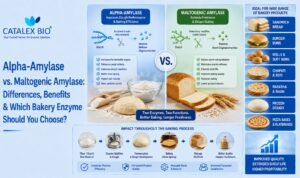
Introduction
Selecting the right enzyme can significantly influence the quality, consistency, shelf life, and profitability of commercial bakery products. Among the most widely used starch-modifying enzymes are Alpha-Amylase and Maltogenic Amylase. While both belong to the amylase family and act on starch, they perform distinct functions during bread production and are often used to achieve different formulation objectives.
For bakery manufacturers, bread improver producers, and food ingredient companies, choosing the wrong enzyme can result in inconsistent fermentation, poor loaf volume, faster bread staling, or unnecessary formulation costs. Understanding the differences between these enzymes is therefore essential for developing high-quality baked products that meet consumer expectations.
At Catalex Bio, we manufacture and supply high-performance Alpha-Amylase and Maltogenic Amylase enzymes for industrial bakeries, bread improver manufacturers, and food processing companies worldwide. Our products are supported by complete technical documentation—including Technical Data Sheets (TDS), Certificates of Analysis (COA), Material Safety Data Sheets (MSDS/SDS), application guidance, and evaluation samples—helping customers confidently validate enzyme performance before commercial implementation.
This guide compares Alpha-Amylase and Maltogenic Amylase from both a technical and commercial perspective. Whether your objective is improving dough handling, increasing loaf volume, extending shelf life, or developing premium bakery formulations, this article will help you identify the most suitable enzyme solution for your application.
Quick Answer: Which Enzyme Should You Choose?
Many bakery professionals ask:
Should I use Alpha-Amylase or Maltogenic Amylase?
The answer depends on what you want to improve.
- If your objective is better dough handling, stronger fermentation, improved oven spring, and increased loaf volume, Alpha-Amylase is generally the preferred choice.
- If your priority is delaying bread staling, maintaining crumb softness, and extending shelf life, Maltogenic Amylase is the better solution.
- For many industrial bakeries, the optimal approach is to use both enzymes together, as they perform complementary rather than competing functions.
Table 1. Quick Comparison
| Your Objective | Recommended Enzyme |
|---|---|
| Improve dough machinability | Alpha-Amylase |
| Enhance yeast fermentation | Alpha-Amylase |
| Increase loaf volume | Alpha-Amylase |
| Improve oven spring | Alpha-Amylase |
| Delay bread staling | Maltogenic Amylase |
| Extend bread shelf life | Maltogenic Amylase |
| Maintain crumb softness | Maltogenic Amylase |
| Achieve both excellent processing and extended freshness | Combination of Alpha-Amylase + Maltogenic Amylase |
While this table provides a quick recommendation, understanding why each enzyme behaves differently requires a closer look at starch chemistry and the role enzymes play during baking.
1. Why Amylase Enzymes Matter in Modern Bakeries
Flour is composed primarily of starch, which typically accounts for 65–75% of its composition. However, native starch is not readily available for yeast fermentation or capable of maintaining bread softness throughout storage. Without enzymatic modification, bread quality and production consistency can be significantly affected.
Starch consists of two major components:
- Amylose – a mostly linear starch molecule that contributes to crumb structure.
- Amylopectin – a highly branched starch molecule responsible for much of the texture and freshness of baked products.
During baking, starch granules gelatinize and form the structure of the bread crumb. As the bread cools and ages, these starch molecules gradually reorganize into a more crystalline structure—a natural process known as starch retrogradation. This process causes the crumb to become firmer over time and is the primary reason bread loses its fresh texture during storage.
Commercial bakeries face several challenges related to starch behavior, including:
- Inconsistent dough handling
- Limited fermentable sugars for yeast
- Reduced loaf volume
- Poor crumb structure
- Faster bread staling
- Shorter product shelf life
- Increased product returns and food waste
Amylase enzymes help overcome these challenges by modifying starch at different stages of the baking process.
Alpha-Amylase primarily acts during dough preparation and baking. It breaks down starch into smaller carbohydrates, providing additional fermentable sugars for yeast and improving dough performance.
Maltogenic Amylase, in contrast, performs its most valuable role after baking. By modifying starch molecules involved in retrogradation, it slows crumb firming and helps maintain bread softness throughout storage.
Although both enzymes belong to the amylase family, they are designed to solve different manufacturing challenges. Rather than viewing them as alternatives, many industrial bakeries use them together to optimize both production efficiency and finished product quality.
2. Understanding Alpha-Amylase
Alpha-Amylase is one of the most widely used industrial enzymes in the food processing industry. It belongs to the endo-amylase group of enzymes, meaning it hydrolyzes internal α-1,4 glycosidic bonds within starch molecules. This action rapidly converts large starch polymers into smaller dextrins, maltose, and oligosaccharides that are more readily utilized during food processing.
Because of its efficient starch-hydrolyzing capability, alpha-amylase has applications across multiple industries, including bakery, brewing, distilling, starch processing, sweetener manufacturing, and cereal processing. In commercial baking, fungal alpha-amylase is particularly preferred because of its moderate activity and excellent compatibility with standard baking conditions.
Unlike maltogenic amylase, whose primary role is extending bread freshness after baking, alpha-amylase is mainly used to improve dough performance during production.
2.1 How Alpha-Amylase Works
Flour naturally contains starch, but only a small portion is immediately available for yeast fermentation. During mixing and proofing, alpha-amylase breaks down damaged starch granules into smaller carbohydrates, producing dextrins and maltose that serve as a food source for baker’s yeast.
This increased sugar availability supports:
- Faster and more consistent fermentation
- Improved gas production
- Better dough handling
- Stronger oven spring
- Increased loaf volume
- Improved crumb structure
- More uniform crust color through enhanced Maillard browning
Since alpha-amylase acts primarily during dough preparation and baking, its influence is greatest before the bread leaves the oven. While it may contribute modestly to initial crumb softness, it is not considered a dedicated anti-staling enzyme.
2.2 Key Benefits of Alpha-Amylase in Commercial Baking
For industrial bakeries, alpha-amylase delivers both technical and economic advantages by improving process consistency and finished product quality.
Key benefits include:
- Improved dough machinability
- Enhanced yeast fermentation
- Better oven spring
- Increased loaf volume
- More uniform crumb structure
- Improved crust color
- Greater batch-to-batch consistency
- Reduced variation caused by flour quality differences
These benefits make alpha-amylase a standard ingredient in many bread improvers and commercial bakery formulations.
2.3 Typical Technical Characteristics
The operating characteristics of alpha-amylase vary depending on the microbial source and product formulation. The values below represent typical ranges for fungal alpha-amylase used in bakery applications.
Table 2. Typical Properties of Fungal Alpha-Amylase
| Parameter | Typical Value |
|---|---|
| Enzyme Type | Endo-amylase |
| Primary Substrate | Starch |
| Main Reaction | Hydrolysis of internal α-1,4 glycosidic bonds |
| Primary Products | Dextrins, maltose and oligosaccharides |
| Typical Optimum pH | 4.5–6.0 |
| Effective pH Range | 4.0–7.0 |
| Typical Optimum Temperature | 50–60°C |
| Primary Function | Improve fermentation and dough performance |
| Major Food Applications | Bakery, brewing, distilling, starch processing |
Note: Actual operating conditions and enzyme activity vary depending on the production strain and commercial formulation. Always refer to the supplier’s Technical Data Sheet (TDS) for product-specific specifications.
2.4 Beyond Bakery: Other Food Applications of Alpha-Amylase
One of the major advantages of alpha-amylase is its versatility. Unlike maltogenic amylase, which is used predominantly in bakery applications, alpha-amylase plays a critical role in several food processing industries.
Common applications include:
- Brewing: Converts starch into fermentable sugars during mashing.
- Distilling & Ethanol Production: Improves starch liquefaction and alcohol yield.
- Starch Processing: Produces dextrins and prepares starch for saccharification.
- Glucose & Maltose Syrup Manufacturing: Performs the initial hydrolysis of starch before further enzymatic conversion.
- Breakfast Cereals: Improves starch functionality and processing characteristics.
This broad application profile makes alpha-amylase one of the world’s most commercially important industrial enzymes.
3. Understanding Maltogenic Amylase
While alpha-amylase is a versatile starch-hydrolyzing enzyme, maltogenic amylase is a highly specialized enzyme developed primarily for the baking industry. Its principal function is not to improve fermentation, but to delay bread staling and maintain crumb softness during storage.
For manufacturers of packaged bread, burger buns, rolls, and other baked goods, freshness is a key quality attribute. Consumers expect bakery products to remain soft for several days after purchase, making shelf-life extension an important commercial objective.
Maltogenic amylase addresses this challenge by modifying starch in a way that slows starch retrogradation—the natural process responsible for crumb firming after baking.
3.1 How Maltogenic Amylase Works
Unlike alpha-amylase, maltogenic amylase selectively hydrolyzes starch chains, producing mainly maltose and short maltooligosaccharides while modifying amylopectin structures involved in retrogradation.
Instead of maximizing starch breakdown, the enzyme changes starch architecture sufficiently to slow recrystallization during storage. As a result, baked products remain softer and retain a fresher eating quality for longer.
Its greatest impact is therefore seen after baking, rather than during dough preparation.
3.2 Key Benefits of Maltogenic Amylase
For commercial bakeries, maltogenic amylase offers several important advantages:
- Delays bread staling
- Maintains crumb softness
- Extends product shelf life
- Improves eating quality throughout storage
- Reduces product returns caused by firmness
- Helps reduce food waste across the supply chain
These benefits have made maltogenic amylase a standard ingredient in premium bread improver systems and packaged bakery products.
3.3 Typical Technical Characteristics
Table 3. Typical Properties of Maltogenic Amylase
| Parameter | Typical Value |
|---|---|
| Enzyme Type | Maltogenic amylase |
| Primary Substrate | Starch |
| Primary Function | Delay starch retrogradation |
| Main Commercial Benefit | Extend freshness and maintain crumb softness |
| Typical Optimum pH | 5.0–6.5 |
| Effective pH Range | 4.5–7.0 |
| Typical Optimum Temperature | 50–65°C |
| Major Food Applications | Bread, buns, rolls, frozen dough and bread improvers |
Like alpha-amylase, operating conditions vary depending on the product formulation and enzyme source. Product-specific technical documentation should always be consulted during formulation and scale-up.
3.4 Why Maltogenic Amylase Is Primarily Used in Bakery
Unlike alpha-amylase, maltogenic amylase has a relatively narrow application profile because its greatest value lies in controlling bread staling rather than general starch hydrolysis.
Today, it is widely used in:
- Sandwich bread
- White and whole wheat bread
- Burger buns
- Hot dog buns
- Dinner rolls
- Sweet buns
- Frozen dough
- Pizza dough
- Bread improver formulations
For manufacturers of packaged baked goods, maltogenic amylase has become one of the most effective enzymatic tools for improving freshness and extending shelf life without compromising product quality.
4. Alpha-Amylase vs. Maltogenic Amylase: Technical Comparison
Although both enzymes belong to the amylase family and hydrolyze starch, they are designed to achieve different objectives in commercial baking. Understanding these technical differences enables bakery manufacturers to select the right enzyme—or the right combination—for their specific products and processing conditions.
A common misconception is that maltogenic amylase is simply a more advanced version of alpha-amylase. In reality, the two enzymes perform complementary roles. Alpha-amylase improves dough performance during production, while maltogenic amylase preserves bread quality after baking by delaying starch retrogradation.
4.1 Mechanism of Action
The key distinction between these enzymes lies in how they act on starch molecules.
Alpha-amylase is an endo-acting enzyme that randomly cleaves internal α-1,4 glycosidic bonds within starch. This rapidly reduces starch into dextrins, maltose, and oligosaccharides, increasing the availability of fermentable sugars for yeast and supporting dough development.
Maltogenic amylase, by contrast, acts in a more controlled manner. It modifies starch chains—particularly amylopectin—by producing mainly maltose and short-chain oligosaccharides. This slows starch recrystallization during storage, delaying crumb firming and extending freshness.
In simple terms:
- Alpha-Amylase improves the baking process.
- Maltogenic Amylase improves the quality of bread after baking.
Table 4. Mechanism of Action Comparison
| Property | Alpha-Amylase | Maltogenic Amylase |
|---|---|---|
| Enzyme Type | Endo-amylase | Specialized maltogenic amylase |
| Primary Action | Random hydrolysis of internal α-1,4 glycosidic bonds | Controlled modification of starch responsible for retrogradation |
| Main Products | Dextrins, maltose and oligosaccharides | Mainly maltose and short maltooligosaccharides |
| Primary Stage of Action | Dough mixing, proofing and baking | Baking and post-baking storage |
| Primary Commercial Benefit | Improved fermentation and loaf volume | Delayed staling and extended shelf life |
4.2 Operating Conditions
Both enzymes function effectively under standard bakery processing conditions, although their optimum pH and temperature ranges differ slightly depending on the production strain and commercial formulation.
Table 5. Typical Operating Conditions
| Parameter | Alpha-Amylase (Fungal) | Maltogenic Amylase |
|---|---|---|
| Typical Optimum pH | 4.5–6.0 | 5.0–6.5 |
| Effective pH Range | 4.0–7.0 | 4.5–7.0 |
| Effective Temperature Range | 30–65°C | 35–70°C |
| Inactivated During Baking | Yes | Yes |
*Thermal stability depends on the specific commercial product.
Note: These values represent typical operating ranges. Actual enzyme performance varies depending on activity, formulation, and manufacturing process. Always refer to the supplier’s Technical Data Sheet (TDS) for product-specific recommendations.
4.3 Performance in Commercial Baking
Although both enzymes improve bakery product quality, they influence different quality attributes.
Alpha-amylase primarily enhances processing performance, whereas maltogenic amylase primarily improves consumer-perceived freshness during storage.
Table 6. Functional Performance Comparison
| Quality Parameter | Alpha-Amylase | Maltogenic Amylase |
|---|---|---|
| Dough Handling | ★★★★★ | ★★☆☆☆ |
| Fermentation Support | ★★★★★ | ★☆☆☆☆ |
| Oven Spring | ★★★★★ | ★★☆☆☆ |
| Loaf Volume | ★★★★★ | ★★★☆☆ |
| Fresh Bread Softness | ★★★☆☆ | ★★★★★ |
| Shelf-Life Extension | ★★☆☆☆ | ★★★★★ |
| Anti-Staling Performance | ★☆☆☆☆ | ★★★★★ |
| Freshness Retention | ★★☆☆☆ | ★★★★★ |
For many industrial bakeries, these enzymes are complementary rather than competing. Alpha-amylase improves manufacturing performance, while maltogenic amylase enhances the quality of the finished product throughout its shelf life.
4.4 Dosage Considerations
Selecting the correct dosage is as important as selecting the right enzyme. Under-dosing may not deliver the desired performance, while excessive dosing can negatively affect dough handling and finished product quality.
The optimum dosage depends on factors such as:
- Flour quality and damaged starch content
- Bread formulation
- Desired shelf life
- Processing conditions
- Enzyme activity (AAU, MANU, etc.)
- Supplier recommendations
General Guidelines
Alpha-Amylase
Typically used to improve fermentation, dough handling, and loaf volume. Excessive dosage may lead to sticky dough or a gummy crumb due to over-hydrolysis of starch.
Maltogenic Amylase
Usually applied at lower dosage levels because of its high activity. Overdosing may result in an excessively soft or slightly gummy crumb, particularly in products with shorter intended shelf lives.
Important: Enzyme activities are not standardized across manufacturers. Dosage should always be optimized through laboratory and production-scale trials using the supplier’s recommended activity units.
4.5 Which Enzyme Should You Choose?
Rather than asking “Which enzyme is better?”, bakery manufacturers should ask:
“Which production challenge am I trying to solve?”
Table 7. Enzyme Selection Guide
| If Your Goal Is… | Recommended Enzyme |
|---|---|
| Improve dough machinability | Alpha-Amylase |
| Enhance yeast fermentation | Alpha-Amylase |
| Increase loaf volume | Alpha-Amylase |
| Improve oven spring | Alpha-Amylase |
| Delay bread staling | Maltogenic Amylase |
| Extend packaged bread shelf life | Maltogenic Amylase |
| Maintain crumb softness | Maltogenic Amylase |
| Improve both production efficiency and shelf life | Alpha-Amylase + Maltogenic Amylase |
For most industrial bread manufacturers, the best solution is often a combination of both enzymes. Alpha-amylase supports efficient dough development and consistent baking performance, while maltogenic amylase helps maintain softness and freshness throughout the product’s intended shelf life.
The ideal formulation, however, depends on flour quality, product type, processing conditions, packaging, and target shelf life. Conducting application trials with technical support from your enzyme supplier is the most effective way to optimize enzyme selection and dosage.
Key Takeaways
Alpha-amylase and maltogenic amylase are not interchangeable enzymes. Although both modify starch, they solve different manufacturing challenges.
- Choose Alpha-Amylase to improve fermentation, dough handling, oven spring, and loaf volume.
- Choose Maltogenic Amylase to delay staling, maintain crumb softness, and extend shelf life.
- Use both enzymes together when your objective is to maximize processing efficiency while delivering consistently fresh, high-quality bakery products.
5. Commercial Bakery & Flatbread Applications: Where Each Enzyme Delivers the Greatest Value
Although Alpha-Amylase and Maltogenic Amylase both act on starch, their greatest commercial value lies at different stages of the baking process. Alpha-Amylase primarily enhances dough processing and baking performance, while Maltogenic Amylase improves the quality of the finished product by maintaining softness and delaying staling.
For industrial bakeries and commercial flatbread manufacturers, selecting the right enzyme is more than a technical decision—it directly influences production efficiency, product consistency, shelf life, customer satisfaction, and overall profitability.
5.1 Bread Manufacturing
Bread is the largest commercial application for both Alpha-Amylase and Maltogenic Amylase.
During dough preparation, Alpha-Amylase generates fermentable sugars that support yeast activity, resulting in improved fermentation, stronger oven spring, better loaf volume, and a more uniform crumb structure.
After baking, Maltogenic Amylase becomes increasingly valuable by slowing starch retrogradation, helping maintain crumb softness and delaying the natural firming that occurs during storage. This is especially important for packaged bread distributed through retail channels, where freshness is a key quality attribute.
5.2 Sandwich Bread
Packaged sandwich bread requires both excellent processing performance and extended freshness throughout its shelf life.
Alpha-Amylase contributes to consistent dough development, loaf volume, and crumb structure, while Maltogenic Amylase helps preserve softness during storage and distribution.
For premium sandwich bread, combining both enzymes typically provides:
- Consistent fermentation
- Better loaf volume
- Soft, uniform crumb
- Extended freshness
- Improved consumer eating experience
5.3 Burger Buns, Hot Dog Buns and Soft Rolls
Products supplied to quick-service restaurants (QSRs) and food-service operators demand exceptional consistency.
These products must maintain:
- Uniform size and volume
- Soft texture
- Good slicing characteristics
- Resistance to drying during storage
- Consistent quality across production batches
Alpha-Amylase improves dough performance and oven spring, while Maltogenic Amylase helps maintain softness throughout transportation and storage.
5.4 Sweet Buns and Enriched Bakery Products
Enriched doughs containing higher levels of sugar and fat often require additional processing support.
Typical applications include:
- Brioche
- Sweet buns
- Milk bread
- Dinner rolls
- Other enriched bakery products
Alpha-Amylase promotes consistent fermentation and dough handling, while Maltogenic Amylase helps retain the soft texture and freshness consumers expect from premium baked goods.
5.5 Frozen Dough
Frozen dough production places additional stress on dough structure and yeast activity, making enzyme selection particularly important.
A well-balanced enzyme system can improve:
- Dough stability after thawing
- Fermentation consistency
- Oven spring
- Finished product softness
- Shelf life after baking
For many frozen dough formulations, combining Alpha-Amylase and Maltogenic Amylase delivers the best balance between production performance and finished product quality.
5.6 Chapati, Roti and Other Flatbreads
While bread remains the largest application for amylase enzymes, Alpha-Amylase and Maltogenic Amylase are also widely used in the commercial production of Indian flatbreads, including chapati, roti, naan, kulcha, paratha, and similar wheat-based products.
One of the biggest quality challenges in packaged or semi-processed flatbreads is maintaining softness after cooking. Freshly prepared chapatis and rotis are naturally soft and flexible, but during storage they gradually become firmer due to starch retrogradation and moisture redistribution. This affects texture, foldability, and overall eating quality.
Alpha-Amylase improves dough machinability and processing consistency, making it particularly valuable for automated chapati and flatbread production lines.
Maltogenic Amylase helps maintain softness after cooking by slowing starch retrogradation. For manufacturers of packaged chapatis, ready-to-eat rotis, frozen parathas, and food-service flatbreads, it can significantly improve freshness and consumer acceptance throughout the intended shelf life.
Typical commercial applications include:
- Packaged chapati
- Ready-to-eat roti
- Frozen paratha
- Naan
- Kulcha
- Tortillas and other wheat-based flatbreads
As demand for convenient packaged flatbreads continues to grow, many manufacturers are adopting enzyme-based solutions to improve product consistency, softness, and shelf life while reducing reliance on chemical softeners.
5.7 Pizza Bases and Other Specialty Doughs
Although shelf-life extension is generally less critical than in packaged bread, enzyme technology can still improve dough handling and product consistency.
Alpha-Amylase is commonly used in products such as:
- Pizza bases
- Tortillas
- Flatbreads
- Specialty dough products
Where extended softness is required—particularly for packaged or refrigerated products—Maltogenic Amylase may also be incorporated.
Table 8. Performance Across Major Bakery & Flatbread Applications
| Product | Alpha-Amylase | Maltogenic Amylase | Recommended Approach |
|---|---|---|---|
| Sandwich Bread | ★★★★★ | ★★★★★ | Use both enzymes |
| White Bread | ★★★★★ | ★★★★★ | Use both enzymes |
| Whole Wheat Bread | ★★★★★ | ★★★★★ | Use both enzymes |
| Burger Buns | ★★★★★ | ★★★★★ | Use both enzymes |
| Hot Dog Buns | ★★★★★ | ★★★★★ | Use both enzymes |
| Dinner Rolls | ★★★★☆ | ★★★★★ | Use both enzymes |
| Sweet Buns | ★★★★☆ | ★★★★★ | Use both enzymes |
| Chapati / Roti | ★★★★☆ | ★★★★☆ | Application dependent |
| Naan / Kulcha | ★★★★☆ | ★★★★☆ | Use both enzymes for packaged products |
| Frozen Paratha | ★★★★★ | ★★★★★ | Use both enzymes |
| Frozen Dough | ★★★★★ | ★★★★☆ | Use both enzymes |
| Pizza Dough | ★★★★☆ | ★★★☆☆ | Application dependent |
5.8 Can Alpha-Amylase and Maltogenic Amylase Be Used Together?
Yes. In fact, many commercial bread improver formulations combine both enzymes because they perform complementary functions rather than competing ones.
Alpha-Amylase improves dough processing by enhancing fermentation, oven spring, and loaf volume. Maltogenic Amylase complements these benefits by delaying starch retrogradation, helping baked products remain softer for longer.
The optimum dosage depends on flour quality, formulation, enzyme activity, processing conditions, packaging, and target shelf life. Laboratory and production-scale trials are therefore recommended to optimize performance for each application.
Table 9. Which Bakery Objective Does Each Enzyme Address?
| Bakery Objective | Alpha-Amylase | Maltogenic Amylase |
|---|---|---|
| Improve dough machinability | ✓✓✓ | ✓ |
| Enhance yeast fermentation | ✓✓✓ | — |
| Improve oven spring | ✓✓✓ | ✓ |
| Increase loaf volume | ✓✓✓ | ✓ |
| Maintain crumb softness | ✓ | ✓✓✓ |
| Delay starch retrogradation | — | ✓✓✓ |
| Extend packaged product shelf life | ✓ | ✓✓✓ |
| Reduce product returns due to staling | ✓ | ✓✓✓ |
Key Takeaways
For most commercial bakeries and industrial flatbread manufacturers, the question is not Alpha-Amylase versus Maltogenic Amylase, but how to use each enzyme most effectively.
If your primary objective is improving fermentation, dough handling, oven spring, and loaf volume, Alpha-Amylase is the preferred choice. If maintaining softness, delaying staling, and extending shelf life are your priorities, Maltogenic Amylase delivers the greatest benefit.
For premium bread, buns, rolls, chapatis, rotis, parathas, and other packaged baked products, combining both enzymes often provides the best balance of manufacturing efficiency, product quality, and shelf-life performance.
6. Frequently Asked Questions (FAQs)
1. What is the main difference between Alpha-Amylase and Maltogenic Amylase?
Alpha-Amylase primarily improves dough processing by enhancing fermentation, dough handling, oven spring, and loaf volume. Maltogenic Amylase mainly delays starch retrogradation, helping bread remain softer for longer and extending shelf life.
2. Which enzyme is better for bread making?
Neither enzyme is universally better—they solve different problems. Alpha-Amylase improves the baking process, while Maltogenic Amylase improves bread freshness after baking. Many commercial bakeries use both enzymes together.
3. Can Alpha-Amylase and Maltogenic Amylase be used together?
Yes. Combining the two enzymes is common in industrial bakery formulations because they provide complementary benefits throughout the production cycle.
4. Does Maltogenic Amylase increase loaf volume?
Its primary role is not to increase loaf volume. It is mainly used to delay bread staling and maintain crumb softness during storage.
5. Does Alpha-Amylase extend bread shelf life?
Alpha-Amylase may contribute slightly to initial crumb softness, but it is not considered a dedicated anti-staling enzyme. Maltogenic Amylase is generally preferred when shelf-life extension is the primary objective.
6. Is Maltogenic Amylase used outside bakery applications?
Commercially, Maltogenic Amylase is used predominantly in bakery products such as bread, buns, rolls, frozen dough, and packaged flatbreads. Its applications outside bakery are relatively limited.
7. What factors should be considered when selecting an enzyme?
Key considerations include:
- Flour quality
- Product type
- Processing conditions
- Target shelf life
- Required crumb softness
- Enzyme activity
- Packaging and distribution conditions
Application trials and technical support from the enzyme supplier are recommended before commercial implementation.
7. Why Choose Catalex Bio?
Choosing the right enzyme is only part of the equation. Selecting an experienced manufacturing partner is equally important.
Catalex Bio is a trusted manufacturer and supplier of industrial enzyme solutions serving customers across the bakery, food processing, animal nutrition, textile, detergent, leather, and other industrial sectors.
For commercial bakery applications, we offer high-performance Alpha-Amylase and Maltogenic Amylase enzymes designed to improve production efficiency, product consistency, and finished product quality.
Our Bakery Enzyme Solutions Include
- Alpha-Amylase for improved fermentation, dough handling, and loaf volume
- Maltogenic Amylase for delayed staling and extended freshness
- Technical guidance for enzyme selection and dosage optimization
- Consistent product quality for industrial-scale production
- Reliable domestic and international supply
Every Commercial Supply Is Supported With
- Technical Data Sheet (TDS)
- Certificate of Analysis (COA)
- Material Safety Data Sheet (MSDS/SDS)
- Product specifications
- Application guidance
- Evaluation samples (subject to our sampling policy)
- Technical assistance during laboratory trials and production scale-up
Whether you are developing a new bakery formulation or optimizing an existing product, our technical team can help identify the most suitable enzyme solution for your application.
8. Conclusion
Although Alpha-Amylase and Maltogenic Amylase both belong to the amylase family, they are designed to solve different challenges in commercial baking.
Alpha-Amylase is the preferred choice for improving fermentation, dough handling, oven spring, and loaf volume, while Maltogenic Amylase is the enzyme of choice for delaying staling, maintaining crumb softness, and extending shelf life.
Rather than competing technologies, these enzymes often work best together. By combining the processing benefits of Alpha-Amylase with the freshness benefits of Maltogenic Amylase, commercial bakeries can produce high-quality products with improved consistency, superior eating quality, and longer shelf life.
If you’re looking for a reliable Alpha-Amylase manufacturer or Maltogenic Amylase supplier, Catalex Bio can provide high-quality enzyme solutions backed by technical expertise, comprehensive documentation, and application support to help optimize your bakery formulations and production processes.